Last Month of Year of the Chief Petty Officer

These are the last few days of the Year of the Chief.  1 April 2013 will mark the 120th Anniversary of the Chief Petty Officer.  By any measure, the past year has not been the best one for our Navy Chief Petty Officers.  Having been raised by Chiefs since first joining the Navy on 14 July 1975 and enjoying their support for 30 years, I can understand their trepidation over the changes involved with embracing CPO 365.  Back in 2007, I enjoined our Navy Chiefs to “Anchor Up, Chiefs ! Reset The Mess” HERE.  MCPONs Campa and West adopted my anthem and MCPON Stevens continues with “ZEROING IN ON EXCELLENCE”, which the Navy has been championing since the 1980s.  We need to keep working together to, again, make “Ask The Chief” the highest form of professional compliment rather than the pejorative it has become alongside “Shipmate”.

Retirement Announcement

In his monthly OPNAV N2/N6 Newsletter, Vice Admiral Kendall Card announced he would retire in about six months.

This is his note to the Information Dominance Community:

“In case you have not heard, I have decided to retire from active duty and will hang up my uniform for the last time in about six months. These kinds of decisions are never easy, but I have enjoyed a wonderful 35 years in service to our country and I am proud to say that the last two years as head of the IDC have been the best of all! I am enormously proud of what we have accomplished together, and completely confident you will continue to excel, and lead the Navy into the next phase of modern warfare. My relief has not yet been identified, but you can rest assured the CNO will pick the right flag officer, and I am certain you will all provide him or her with the same level of outstanding support you gave me; our Navy needs nothing less than your best! In the meantime, I refuse to slow down, particularly given the budget uncertainties and operational challenges we face over the next several months. I will keep you fully apprised as this transition unfolds, but for now, let’s all maintain the full court press!”

Kendall Card
Vice Admiral, U.S. Navy
Deputy Chief of Naval Operations for Information Dominance

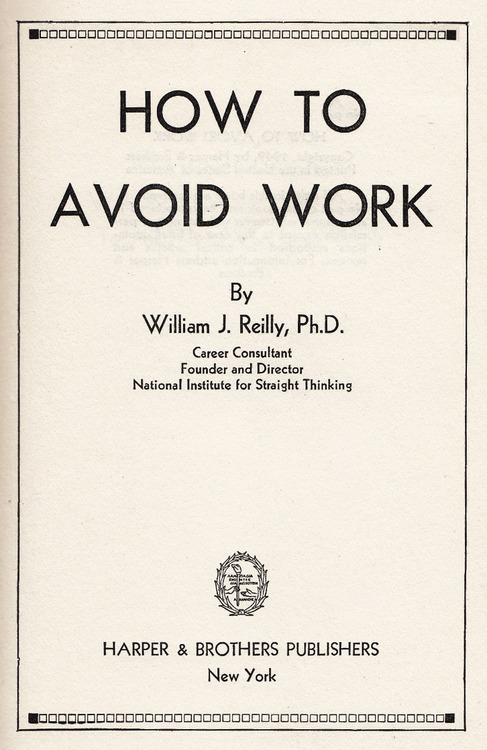
You know, I thought that I knew the guy who wrote this book

I worked pretty hard for a Captain who certainly could have written this book.  Turns out, he would have been about 50 years too late in the writing.  He certainly perfected the art of avoiding work.  Never did get his Ph.D. though and was neither a straight shooter nor a straight thinker.
That’s my shot over the bow.
I just saw this book cover and it made me smile.  I’ve never been afraid of work of any kind.  But I’ve certainly worked for men and women who were.
I remember one boss telling me, “Hard work never killed anyone, but why take the risk?”  (I’m sure he stole that from someone else.)
Sometimes your boss’s only purpose may be to serve as a bad example.  There’s a leadership lesson in there somewhere.

Letting it go – just can’t do it

One of my challenges has been to let go of things. I’ve said before that I have carried experiences and friendships with me over my 30 year Navy career from day one of boot camp in San Diego on 14 July 1975 to the last day of May in 2006 at the Pentagon. I am proud to say that I am still in touch with my Recruit Chief Petty Officer (RCPO) and several others from Company 929 in 1975 and with the Secretary of Defense from my 2 year assignment as his staff director for the Detainee Task Force. And I am still in touch with many folks from every assignment in between.   These aren’t FaceBook, Twitter, Google+, TogetherWeServed, or LinkedIN connections – they are far more than that.
One of the tougher things to let go of is my time in charge – as OIC of NSGD Barbers Point, Hawaii and as Commanding Officer, U.S. Naval Security Group Activity Yokosuka (now Navy Information Operations Command). As the person in charge, I think we connect ourselves more to the legacy of those organizations where we held the ultimate responsibility and authority.  As Commanding Officer, it is particularly tough to let go of the team that you have led.  Over the years since command, I have watched MY Sailors grow to the point that three of them will be the Commanding Officer, Executive Officer and Command Master Chief of ‘my’ former command – U.S. NSGA Yokosuka this summer.  There is a great deal of shared pride in their many achievements.  And, another one of my Sailors also served as officer in charge of ‘my’ former detachment NSGD Barbers Point.  The circle of “our” leadership is expanding and remains unbroken.

Do you stay genuinely CONNECTED to your Shipmates or do you simply steam on?

"Brilliant" on the basics? Some commands don’t even have the light on.

If you were to assess your command in these six categories, how would you score?
The foundation for success in any command can, in part, be attributed to these six areas that form the enduring foundation upon which a successful career can be launched: 
1. Sponsorship/first 72 hours:
Proactive interaction by a sponsor and ombudsman can solve many issues before the Sailor and family arrives aboard. Paving the way for a smooth transition and making each Navy family feel like a genuine part of their new command can ensure a family commitment of support to enable success for all.
2. Assign a Mentor:
Leader’s should be proactive in mentoring; give junior Sailors and peers the benefit of your experience. There are formal and informal means in which to execute an effective mentorship program. Each of us can attribute our own success to a great mentor. Ensure our Sailors understand the value of senior and peer mentorship.
3. Indoctrination:
A great sponsorship program must be followed up by an effective indoctrination program. This will send a strong, positive signal that we value the talent and skills of the Sailor and we have a plan to integrate them into the team. Additionally it immediately sets the tone on what you expect of the Sailor and also what should be expected from you. Requirements and best practices can be found in OPNAVINST 1740.3C.
4. Leadership:
Career Development Boards (CDBs) – Leadership involvement, primarily by the CMC, the Chief’s mess and the Command Career Counselor, is critical to the success of every Sailor. CDBs are required within 30 days of a Sailor reporting aboard, and again at 6 and 12 months. (Many commands can’t get EVALs/FITREPS done on time and you can imagine their success in accomplishing the CDB requirement).
5. Ombudsman program:
Ombudsman are trained to disseminate information from the chain of command to the families, including official command information, Quality Of Life opportunities, and community information. They can also provide referrals and are instrumental in resolving family issues before the issues require extensive command attention. Every Sailor and Family member should know the Command Ombudsman. How do you advertise your Ombudsman?
6. Recognition:
The end of tour should not be the only time a Sailor is recognized. Recognition can also include mid-tour awards, Flag Letters Of Commendation, letters of appreciation, and highlighting accomplishments in the POD and other public venues. Be creative, praise in public, and make your Sailors know they are appreciated. Something as simple as public recognition, a hand shake or a pat on the back often means more than an official award.

More than CYBER: Cryptology remains a critical Fleet Cyber Command Mission Area

From the OPNAVINST on the Missions, Functions and Tasks of Fleet Cyber Command.

3. Cryptologic Operations and Intelligence. COMFLTCYBERCOM is the central operational authority for cryptologic operations.

a. COMFLTCYBERCOM serves as the Navy’s SCC commander to DIRNSA/CHCSS. The SCC serves as the primary Service authority for all operations, programming, budgeting, training, personnel, policy, doctrine, and foreign relationships for cryptologic activities. The SCC commander is also responsible for the development of strategic plans, policy, processes, requirements, architectures and communications.

 b. COMFLTCYBERCOM directs and tasks the operations of its subordinate cryptologic commands to include providing cryptologic support to NCCs and numbered fleets.

c. In appropriate circumstances, COMTENTHFLT and another numbered fleet may agree to shift primary tasking authority of a specific unit or unit’s sensors to the other command for a specified duration of time.

d. COMFLTCYBERCOM directs and manages the Cryptologic Direct Support Augmentation Program. This includes determining force and equipment allocation of direct support equipment and personnel based on NCC numbered fleet stated operational information or effects requirements. These capabilities may be comprised of a combination of forward deployment of personnel, carry-on equipment, and or shore-based support.

e. COMFLTCYBERCOM and COMTENTHFLT direct task forces and commands to support the intelligence and target development requirements of USSTRATCOM, USCYBERCOM, joint force commanders, and naval commanders in support of fires and effects planning.

f. COMFLTCYBERCOM and COMTENTHFLT generate intelligence requirements in support of FLTCYBERCOM and TENTHFLT mission sets.

 g. COMFLTCYBERCOM serves as the intelligence oversight program manager for FLTCYBERCOM units and Navy units for which it sponsors specialized database access. COMFLTCYBERCOM ensures intelligence oversight reports for these units are consolidated and submitted to the Navy Inspector General and the respective database owner. COMFLTCYBERCOM will keep NCCs and numbered fleets informed of any non-compliance with intelligence directives.

h. COMFLTCYBERCOM and COMTENTHFLT maintain Navy cryptologic liaisons at appropriate combat support agencies.

i. COMFLTCYBERCOM and COMTENTHFLT provide support and technical guidance to Navy operating forces on cryptologic matters, to include fielding of approved capabilities.

j. COMFLTCYBERCOM oversees the direction and modernization of the Navy’s cryptologic architecture.

k. COMFLTCYBERCOM serves as a member of the Five Eyes Maritime Cryptologic Committee in support of CNO (N2/N6), the designated U.S. Navy lead.

l. COMFLTCYBERCOM is the Navy’s critical information program manager.

The Sailor Prefers His Talks ‘Neat’ – From the archives

“A Sailor does not want to be mustered on someone else’s mess deck to hear a succession of vague and long-winded discourses on nothing in particular. Neither does he enjoy false heroics or “flannel”. 
 
Like his tot, the Sailor prefers his talks ‘neat’…make certain you have something quite definitive to say, and work out exactly how to say it beforehand. If Winston Churchill has to rehearse all his speeches, there is no reason why you should not.”

Royal Naval Officer’s Guide, 1943

Share A Secret With Your Team

A Sicilian proverb says “Only a spoon knows what is stirring in the pot.”

When you allow a Shipmate, Sailor or subordinate to know what is ‘stirring’ within you, giving a taste or hint of what’s cooking, you are giving him a taste of the plan or idea. You are instantly making a meaningful connection with him. Who doesn’t what to know what the boss is thinking?

Share your ideas – make meaningful connections with your team.  (BTW, a connection doesn’t mean someone hit the “follow” button on your twitter feed.)

From John Maxwell’s – 25 Ways to Win With People

Leadership Changes at Center for Information Dominance Corry Station – Executive Officer

Commander John Markley relieved Commander Paul Wilkes recently as the Executive Officer of the Center for Information Dominance Corry Station in Pensacola Florida. CDR Markley is a career Navy intelligence officer. 
His biography is not yet available on the CID Corry website but here are a few unofficial details: USS George Washington, Senior Intelligence Officer, from December 2010 – February 2013; Evaluator for the DoD Inspector General from December 2008 – December 2010; CVW-1 CAG from May 2004 – May 2006; NMITC from August 2001 – July 2004 (Targeteer, Strike Instructor, Intel Evaluator), NSAWC from July 1998 – June 2001; VFA-97 from June 1996 – June 1998; USS John F. Kennedy from 1988 – 1992 (Enlisted Intelligence Specialist). 

His official bio:

Commander John B. “Skid” Markley Executive Officer
Center for Information Dominance
Corry Station


Cmdr. John Markley was born in San Diego, Calif., and grew up in Garland, Texas. In February, 1988 he enlisted in the U.S. Navy and attended boot camp in Orlando, Fla. He then attended the Navy and Marine Corps Intelligence Training Center (NMITC) qualifying as an Imagery Intelligence Specialist and was detailed to the USS John F. Kennedy (CV 67). During this tour he provided imagery support to strike aircraft conducting operations in Desert Shield and Desert Storm. In 1992 he transferred to the Joint Warfare Analysis Center (JWAC) in Dhalgren, Va., where he obtained his bachelor’s degree through Regents College and was selected to obtain a commission through Officer Candidate School (OCS) in Pensacola, Fla., in 1995.
After OCS, Ens. Markley returned to NMITC for the Intelligence Officer Basic Course (NIOBC), and was subsequently assigned as the Intelligence Officer for the Warhawks of Strike Fighter Squadron (VFA) 97 in Lemoore, Calif. After a successful tour, he was nominated and selected to be the Intelligence Officer for the Navy’s Strike Fighter Weapon School (TOPGUN) at the Naval Strike and Air Warfare Center (NSAWC) in Fallon, Nev.
In August 2001 Lt. Markley transferred to NMITC as an instructor for Strike Warfare. During this time he managed the first iteration of the Intelligence Team Trainer (ITT). Lt. Cmdr. Markley transferred in 2004 to Carrier Air Wing One (CVW-1) as the Carrier Air Wing (CAG) AI in charge of all Air Wing Intelligence requirements. CVW-1 deployed in 2005 on a unique Mediterranean – Gulf – Pacific Fleet and successfully integrated the inaugural deployment of the Shared Reconnaissance Pod (SHARP). In 2007 he attended the Naval War College in Newport, R.I., earning a master’s degree in national security.
After the war college, he reported to the Department of Defense Inspectors General (DoD-IG) Office for Intelligence, where his team of evaluators aggressively pursued hotline allegations and produced four reports to Congress detailing the results of those investigations. Lt. Cmdr. Markley also organized the civilian evaluators and auditors and developed a prioritization process that ensured the most significant issues were rapidly addressed by the DoD-IG.
Before assuming duty at the Center for Information Dominance (CID) as the executive officer in March 2013, Cmdr. Markley was the Senior Intelligence Officer (SIO) onboard the USS George Washington (CVN 73).
His awards include one Defense Meritorious Service Medal, one Joint Commendation Medal, three Navy Commendation Medals, and four Navy Achievement Medals.
BACK