The Navy is raising a generation of officers who believe that technical training is not essential and that they can rely on management techniques to make decisions.
Admiral Rickover
Author: captain1610
Everything honorable and glorious
“It follows then as certain as that night succeeds the day, that without a decisive naval force we can do nothing definitive, and with it, everything honorable and glorious.”
General George Washington, 1781
Admiral of the Cyber Sea
 “No matter how long I live, no matter how many more different jobs I may have, I have already been given the highest reward I’ll ever receive, the privilege and the responsibility of serving very proudly in the United States Navy.”
Rear Admiral Grace Hopper
Vice Admiral Jan E. Tighe is the new “Admiral of the Cyber Sea” as a Ph.D. and the Navy’s Senior Engineer leading our Navy’s TENTH Fleet and Fleet Cyber Command.
16th Anniversary of my failure to screen for command – while in command !!
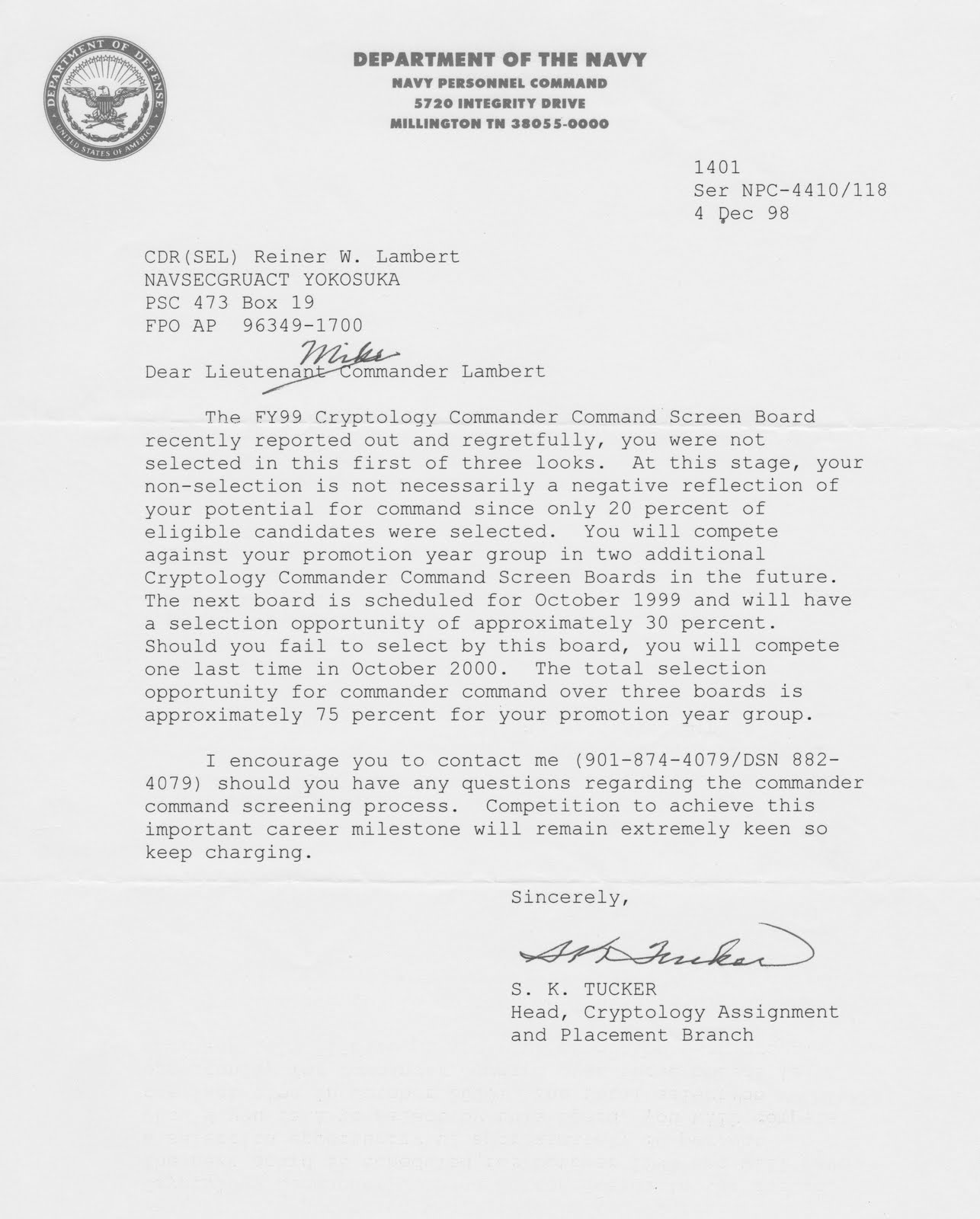
As a Lieutenant Commander, I assumed command of Naval Security Group Activity Yokosuka, Japan (a Commander command) in January 1997 from LCDR Eric Newhouse (the interim CO). The CO previous to Eric had been relieved 6 months earlier, after failing two successive Inspector General inspections – leaving behind demoralized Sailors and a fractured command.
The “Failure to Screen for Command” letter arrived after I had been in command for 23 months and a few days before I put on Commander. Sixteen years later, I remain amused that the Navy bureaucracy put me in O5 command early as a senior O4 and failed to screen me for the job I was already in for nearly two years. 19 days later I received a letter from OPNAV authorizing me to “frock” myself to Commander.
I was not completely surprised by the “FAILURE TO SCREEN FOR COMMAND” letter because a Lieutenant from BUPERS had called two weeks earlier to inform me that I had “FAILED TO SCREEN”. What did surprise me was the fact that I had failed to screen for command – a job that I had held for two years, already and no one in my operational or admin chain of command was aware of the failure.
Thankfully, I didn’t lose my day job. I post this letter for those who have had to deal with the pain of “Failure of Selection” – whether it be for promotion, command or some other program you desperately want. It’s a very painful and emotional thing, one which we try very hard to comprehend. No one ever explained how I failed to screen for a job I already had and was ranked #1. A year later, I “successfully screened” for the assignment that I had been doing for 35 months.
The three compelling secrets to leadership that real leaders understand implicitly
1.
2.
3.
Set a new course in 2015

As we sail toward the end of 2014, “adrift” is a word all too frequently associated with our great Navy. Several problems continue to erode confidence in our Navy’s leadership and none is more insidious than the common perception that integrity can be hazardous to one’s career — especially if it means vocalizing issues that might embarrass the brass.
If allowed to continue unabated, this perception will breed yet “another” generation of cynical, risk-averse naval officers more concerned with getting promoted than with addressing and fixing problems. Responsible criticism has long been considered an act of disloyalty. The Navy should reward integrity – above most other traits. We should consider changing the FITREP systems to include these simple questions: (1) Will this officer deliver the bad news, even when the boss doesn’t want to hear it? (2) Will this officer risk his or her career for the men and women under him?
We should apply some positive steering now and get back on course. Otherwise, we may be heading into shoal waters.
The Standing of The Whole Is Essential

Character and standards of personal conduct remain of highest importance, as has always been true of military leaders. The effective naval officer of the present and future, like his brother of the past, must regard his commission as a career, not a mere job. He dedicates himself to the high ideals of military leadership. Some who receive commissions, all being human, will prove unequal to these standards (e.g. the 22 COs fired in 2011). There have been a few unfortunate events of recent years, well known to most people, which have weakened the standing of the Armed Forces in the eyes of many people. To whatever extent this feeling persists, to that degree the security of the nation has been compromised. People will not entrust willingly their sons or husbands to military leadership, even in time of emergency or war, unless they have abundant faith in the character as well as the professional competence of the great mass of military leaders. The presence of a few names of national prominence will not alone suffice. Ensigns and lieutenants are important, as captains and admirals are important. The standing of the whole is essential. Enlisted men will not willingly and effectively train or fight if they have doubts where there should be confidence.
From: The Naval Officer’s Manual
Admiral Malley’s TEN Rules

VADM Ken Malley (Ret.) was Commander Naval Sea Systems Command and Director, Strategic Systems Programs.
1. Always tell the truth. And when the news is bad, tell it in a hurry.
1. Always tell the truth. And when the news is bad, tell it in a hurry.
2. Never bet your program on technology that exists only on a viewgraph.
3. Never shoot the messenger.
4. Do what is right for the program and the organization.
5. Never accept a task or job (or propose one) without the proper resources to accomplish same.
6. No matter what you think of your boss (or customer), if he or she does not end up being a hero, neither do you.
7. Your people have feelings, too. Treat them accordingly.
8. Your family deserves some of your time.
9. Have fun. If you are not having fun (frustration and fun can be one and the same), seek another line of employment.
10. Don’t ever let your emotions take charge. Do allow yourself to get upset once every two or three years—then pick your target carefully and fire for effect.
See it through

“Few things are more vital to an organization than young officers and leaders who have the moral courage to help shape the direction in which the organization is headed, and then the strength of character to see it through.”
Admiral James Stavridis
Mentor & Friend
Managing your officer career

A key part of managing your officer career will be the counseling you receive. However, the quality of the counseling you receive is only as good as its source. No matter what the advice or the source, the career decisions you make affect your career.
In general, the most reliable sources for career information are your Commanding Officer, Executive Officer and your detailer. COs and XOs are knowledgeable and experienced counselors, able to address both general and specific requirements for your career path. Other, similarly experienced senior officers can help with the detailed requirements of your technical specialty. There are many career considerations which do not change, such as the importance of sustained superior performance. For guidance on specific billet choices in a changing career path, you will need to contact your detailer. Your detailers should know your qualifications, career needs, personal preferences and which billets are available.
 I Like The Cut of His Jib