Sometimes I am just clueless about what’s happening – Mark D. Neighbors has moved from the OPNAV Staff

Senior Advisor
 to the 
Deputy Chief of Naval Operations for Information Dominance
 has left the OPNAV Staff.

Mr. Mark Neighbors enlisted in the U.S. Navy in 1974 and trained in Chinese Mandarin at Defense Language Institute, Monterey, California. After serving in various assignments as an enlisted voice analyst in Korea, Maryland and Hawaii, he was commissioned an Ensign in 1983. He subsequently performed duties in operational and staff assignments ashore and afloat in California, Japan, Maryland and Washington, DC. 

He was the Commander, Task Force 70/Striking Force SEVENTH Fleet cryptologist in the 1990s and was a powerhouse on the Yokosuka waterfront for a number of years, having served as the Officer in Charge, U.S. Naval Security Group Detachment Yokosuka, Japan.

To our great dismay, Mark retired as Commander in 2001. He entered the U.S. Civil Service and served in several staff intelligence assignments at the U.S. Navy Headquarters (OPNAV).

He was selected as a Defense Intelligence Senior Level (DISL) in 2007 during a three year assignment as the Navy’s Deputy Senior Language Authority.

In September 2008 he reported to the staff of the Director, Naval Intelligence where he facilitated the OPNAV Headquarters reorganization in 2009 and became Chief of Staff to the Deputy Chief of Naval Operations for Information Dominance. In January 2010 he executed a Joint Duty Assignment with the Defense Intelligence Agency where he developed the Civilian Foreign Area Specialist (CIVFAS) Program for the Defense Intelligence Enterprise. He returned to OPNAV in February 2011 and serves as the Senior Advisor to the Deputy Chief of Naval Operations for Information Dominance (N2/N6).

Mr. Neighbors holds a bachelors of general studies in political science from Chaminade University, Honolulu, Hawaii and a masters of science in national resource strategy from National Defense University in Washington, DC. He is a graduate of the Massachusetts Institute of Technology’s SEMINAR XXI Program, and a recipient of the Department of the Navy Superior Civilian Service Award. His highest military decoration was the Legion of Merit. 

A serious question to ask yourself today and periodically thereafter

Each of us has served with Navy leaders of both types and we know which one we prefer.  Knowing how effective and energizing a serving leader can be, who would choose to be self-serving?  It really is that simple – will you serve your Sailors or yourself?  

Mark Miller and Ken Blanchard’s book – THE SECRET helps you understand the ‘secret’ of leadership.  Give it a read.  You can read a chapter HERE for free.

I was surprised by these comments by Dr. Martin Cook at Naval War College

From a Navy News article:

“Professionals from all fields must maintain their level of knowledge and development to preserve their social trust”, said Cook.

“When you go to a doctor, you expect them to be reading medical journals; when you go to a lawyer, you expect them to be keeping current on the state of their profession,” said Cook.

“The same is expected from military leaders.”

“For most Navy people this is a relatively new concept, they don’t really think of themselves in these terms. They use the term professional, but that usually means that they are competent,” he added.

During her remarks, RADM Peg Klein underscored Cook’s point.

Dr. Cook must be thinking about some other Navy.  I don’t believe the Sailors I served with thought that “professional” meant you were merely competent.  I must be missing his context. I don’t know many in the Navy who believe that they don’t have to keep current on the state of their profession. Dr. Cook may need to get back out to the Fleet.

Learning and leading are inextricable

Mark Miller and Ken Blanchard are celebrating the 10th Anniversary of the release of their book THE SECRET.  If you missed the lessons the first time, this is your opportunity to catch up.  If you’ve read it before, this is an ideal opportunity to refresh those lessons.  You can find the book at all of the usual book sellers.  Free copies are available for the first ten (10) people who send me a handwritten request via snail mail.  Your 48 cent investment gets you a $22.95 value.  That’s a nice return.  E-mail me at therealnavy@gmail.com and I’ll send you my mailing address.  If you already have my address, you are all set.

10th Anniversary Edition of "The Secret" by Ken Blanchard and Mark Miller

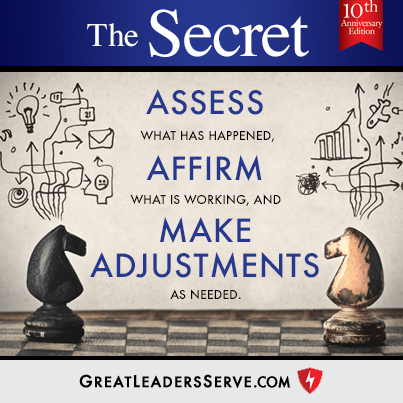
Assess, Affirm and Make Adjustments. These are three things good Navy leaders do every day. This works especially well with Navy evolutions. Most commonly used at sea, this same evolution debriefing process has solid application within our shore establishment in the Information Dominance Corps at our Navy Information Operations Commands.  It’s simple and easy to apply to our many processes.  While we protect many secrets, this one is no leadership secret and should be shared with all.

REWARD & RECOGNITION

“What is honored in a country is cultivated there.” 
Plato
How do you honor the people in your organization? A couple of years ago, I was making a focused effort to improve in this arena. I knew intuitively different people place different value on various types of recognition. However, to truly honor people, I needed to know specifically what was of value to them individually.
My next step was to set a meeting with all the staff members in my department, temporary and part-time employees too. I asked each of them just one question? What was the best recognition they had ever received? The result – I confirmed my hunch regarding the diversity of approaches to effective recognition. Here’s some of what they told me…
Public recognition – Some people love to be recognized in front of other people. You may be one of those individuals. Unless other people can hear the kind words and see the appreciation, it doesn’t count. When you work with these people, be on the lookout for the appropriate forum to showcase the behaviors you’re trying to reinforce.
Private recognition – I don’t know the percentages, but I do know a significant portion of the population will not feel honored if you single them out publically. I’ve worked with many people who feel public recognition is more punishment than praise. If you miss assess this, your good intentions could actually dissuade the behaviors you’re trying to cultivate.
A hand-written note – This simple, seemingly outdated means of communications is still one of the most powerful, and universally appreciated forms of recognition. Throughout my career, I’ve been amazed at the reception I get from writing short notes of appreciation. I don’t write enough of these! P.S. An email is not the same as a personal note.
A plaque or trophy – Some people want the tangible evidence of their accomplishment. These do not have to be elaborate or expensive… they can even be homemade. A few years ago we were trying to inculcate our core values and we made awards for people who went above and beyond in modeling these behaviors.
Cash – I would assume everyone on your team appreciates a paycheck. However, for some of them, to be recognized with cash (or a gift card) is the ultimate. You may be surprised how little money is needed to make a big impact. If you can’t get this through on your expense report, you may want to do it out of your own pocket. A Starbucks card or two may produce exponential returns.
Time off – I hope you’ve been struck by the diversity of methods for recognizing and rewarding people. The list could go on and on, but I don’t want you to miss this one. Many people will feel honored and appreciated if you say, “You did an outstanding  job completing that project on time and on budget! Why don’t you take tomorrow off?”
If you want to drive change in your organization, recognize the behavior you want to see repeated; and recognize it in ways that speak to people individually.
Writing this post has been a good reminder for me. I need to schedule some meetings and ask just one question…
How about you?
Mark Miller, Vice President of Organizational Effectiveness for Chick-fil-A, believes that leadership is not something that’s exclusive; within the grasp of an elite few, but beyond the reach of everyone else.  In the tenth anniversary edition of The Secret, Miller reminds readers of a seemingly contradictory concept: to lead is to serve. With more than 600,000 books in print, Mark has been surprised by the response and delighted to serve leaders through his writing.

The 10thanniversary edition of The Secret will be released September 2, 2014