 Recently, submarine command course instructors from the United States, Great Britain, The Netherlands, and Norway, as well as senior submarine training officers from Australia and Canada (who have submarine forces but currently have no independent submarine command course) met for three days in Pearl Harbor, Hawaii. While there has been a lot of beneficial engagement between the courses’ students and teachers in the past, this landmark opportunity brought all the teachers together to compare and contrast their courses, and to discuss the benefits and nature of future collaboration. The following questions were discussed: Based on the accumulated assessment of the students you taught during your assignments, what are the common threads and characteristics that distinguish the best prospective commanding officers from the worst? What is different about those who ‘get it’ from those who don’t? Submarine command courses prepare officers for submarine command through a process of both teaching and assessment. The price of failure can be high, and while success allows assignment to command, it does not guarantee a successful command. The Submarine Command Course is neither a warfare course nor an academic exercise. It tests leadership, professional knowledge, the desire for excellence, aggressiveness, and a hunger for submarine command. The central focus of the Submarine Command Course is to teach future commanding officers to make good command decisions. Generally there are two types of decisions: analytical and intuitive. To make analytical decisions one weighs options, balancing risk and gain. This type of decision-making is well understood, and is used often by submarine commanding officers. While this is a necessary strength for command, it is neither sufficient, nor a good predictor of tactical or leadership performance. Intuitive decisions are made after one detects cues and patterns that emerge from complex situations, and then chooses a course of action that likely will be successful. The action chosen is based on experience-the person has seen similar situations and draws on a “library” of responses (mental models). Based on recognizing the situation that faces him, the decider quickly converges on a course of action and runs a mental simulation of the action. If the simulation ends with success, he executes that option. If the simulation is not successful, he quickly makes adjustments to correct the difficulty or tries another model, running through the process again, until he finds a successful course of action to take. It is important to realize intuitive decisions are made quickly compared to analytical decisions, and the decider is not comparing options. If the first projected course of action works, he executes. Using the situation facing the student in the Submarine Command Course, we can identify some elements of success:  Good COs can process a lot of data, prioritize important cues, and recognize patterns-they have good situational awareness. Good COs can process a lot of data, prioritize important cues, and recognize patterns-they have good situational awareness.
|
|
|
| This is an incomplete list of some qualities of successful commanding officers. These qualities are inherent in some more than in others. It is possible, by having a structured understanding of intuitive decision-making, to detect natural command potential and to foster it in all junior officers (even those without strong natural abilities). We believe professional development and training that focus on building confident decision-makers can grow these qualities where they are weak, more quickly identify those officers who may not have what it takes to command, and help the naturally gifted officers to soar.
Editor’s Note: All these officers are submarine officers involved in the training of prospective submarine commanding officers and executive officers.
Reprinted from Proceedings with permission; Copyright (c) April 2005 U.S. Naval Institute/www.navalinstitute.org.
|
Author: captain1610
 Knowledge of intuitive decision-making is not well understood, but has applications in most tactical and seamanship scenarios. As a simple example, a CO may recognize the patterns emerging from a crossing situation. (“That contact has a zero bearing rate and port angle on the bow, and will collide with me if nothing is done.”) He then projects a mental simulation of his action based on


I like this from Seth Godin

On the hook
Mentorship works for two reasons. Certainly, the person being mentored gains from advice and counsel and even access to others via introductions, etc.
But mostly, it works because the person with a mentor has a responsibility to stand up and actually get moving. The only way to repay your mentor is by showing the guts it takes to grow and to matter.
Interesting to note, then, that the primary driver of mentor benefit has nothing to do with the mentor herself, nothing beyond the feeling of obligation the student feels to the teacher. Whether or not the mentor does anything, this obligation delivers benefits.
Check out what Seth Godin has to say HERE.
Good Advice over at JO RULES
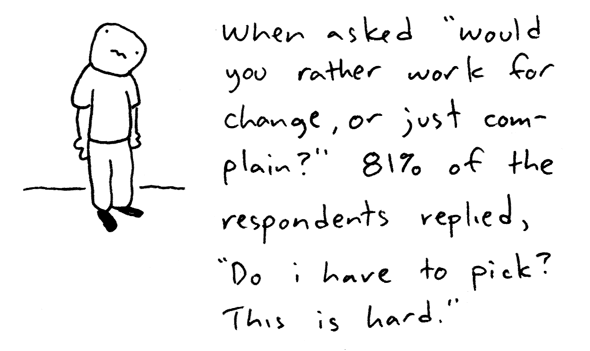
Faced with inevitable change, those who accept the change have the most power to shape the details. It’s not about self-interested conformity or passively accepting defeat; it’s about making decisions based on how things are rather than how we would wish them to be. It’s about seizing the initiative.
When you have legitimate concerns about an order or a policy, you have the right and the obligation to make those concerns known. Be tactful, as the surest way to have your opinion arbitrarily rejected is to frame it as a complaint. Once you’ve voiced your concerns, your duty is to make it work. Fighting it will just cause chaos, but even some of the most harebrained schemes can be saved by determined chiefs and JOs. Think of it as a challenge– if there’s only one person on Earth that could make this plan work, is it you? Who knows, you might even find out that you’re not always right.
Lots more HERE.
Change is much easier to digest if you become a part of the change. There’s always this – from General Eric Shinseki:
“If you don’t like change, you are going to like irrelevance even less.”
LT Jon Paris is a 2005 graduate of The Citadel and a Surface Warfare Officer.
 |
|
| The CNO’s Rapid Innovation Cell is a group of junior leaders tasked with being innovative and coming up with disruptive solutions.” |
He has done some serious thinking about innovation and shares his thoughts HERE. It’s worth your time to read what he has to say.
Smartest person in the room

I met with a small group of IDC officers recently and one of my fellow Captains wanted to make sure all of us understood he was the smartest guy in the room. It wasn’t a declarative verbal statement. But, you readily understood his intent. He professed his sincere apologies for arriving late to our meeting. It wasn’t long before he made it known that his schedule was way overbooked and he really didn’t even have time for the meeting we were currently involved in and he would have to depart early. Thank goodness one of his Sailors brought him his coffee and he had time to take a few sips before he jaunted off for his next meeting for which he was already late. Good thing he was a Captain and those 40 Sailors didn’t mind waiting. Quite the busy man.
I have a NEWS FLASH for you Captain (or anyone else for that matter). Think you’re the smartest person in the room? More than likely you are not.
Success versus significance

John Maxwell makes a good point about success versus significance. The successful officer is adding value to his own career and the significant officer is adding value to the careers of others. I was exchanging ideas with a fellow former CO a few days ago and we discussed “command tours” and measuring the success of our commanding officers. Virtually every O5 command tour ends with the award of a Meritorious Service Medal and O6 command tours typically end with the award of the Legion of Merit.
What evaluation has really gone into the decision to award these significant medals? Are all of these COs successful and equally so? What is being rewarded? Time in command? Achievement? Does it matter? Is it our business? Is it your business?
Apparently not too much, especially if every departing CO is earning one. A recent award tightened my jaw a bit as the departing CO left behind a command in shambles. The new CO would never admit to it, but he inherited a command in near total disarray. The former CO left behind a dismal retention record, no record of mission achievement, >15% command PRT failure, no CPO selectees in the past three cycles and not one single accomplishment that his Sailors could point to with pride and say – “We did that!”
A journey from success to significance takes time. It requires patience and commitment. It doesn’t happen by accident. You must be purposeful in adding value to the careers of your Sailors. You are there as CO to accomplish the mission and to see to it that Sailors perform up to their potential. If you have a bunch of Sailors with “unlimited potential”, you’re leaving a lot of potential on the deck-plates unrealized. Strive for significance. Your Sailors deserve your best effort.
Commander Sean Heritage has written about SUCCESS versus SIGNIFICANCE HERE.
Silence of my Shipmates
“What has hurt the most are not the actions of my seniors but the silence of my Shipmates in the face of those actions.”
Note from afar.
A date which will live in infamy.
More on handwritten notes from John Coleman at Harvard Business Review

It may seem nostalgic, but I still believe there’s room for the handwritten note in personal and professional communication. They cost something, mean something, and have permanence in a way emails and text messages don’t. They let the people in our lives know we appreciate them enough to do something as archaic as pausing for 15 minutes to put pen to paper in an attempt to connect and sustain a relationship with them. I still remember that note — and many others I’ve received over the years — and perhaps in writing personal notes to our friends and colleagues, we can reach out to others in a way that creates a lasting, positive connection.
Try it, you may like it.
CNO Presents 2013 Vice Adm. James Bond Stockdale Leadership Awards
WASHINGTON (NNS) — The annual Vice Adm. James Bond Stockdale Leadership Award ceremony was held in the Pentagon Hall of Heroes Dec. 4.
Cmdr. Richard N. Massie and Cmdr. Leif E. Mollo received the award which recognizes two commissioned officers in the grade of commander or below who contribute to the improvement of leadership in the Navy.
Chief of Naval Operations Adm. Jonathan Greenert was the guest speaker at the ceremony and presented the awards.
“It’s about people; people who are willing to lead and people who are willing to step forward and say ‘I want to write about somebody who is my peer who I think is extraordinary’,” said Greenert. “Taking time to do that in this busy world is remarkable in its own sense.”
Massie, commanding officer of the USS Maine (SSBN 741) Gold Crew was the Pacific Fleet winner. Massie was highly successful with the integration of women onto submarines.
“I was overwhelmed and truly proud of my crew. This was another success and another testament to the great things that that crew has done,” said Massie.
Mollo, commanding officer of SEAL Team 4, was the Fleet Forces Command winner.
Mollo led SEAL Team 8 as its mission changed from Afghanistan to Africa before being hand-selected to command SEAL Team 4.
“The recognition all should go to the warriors and support personnel that I served with at SEAL Team Eight and SEAL Team Four. They inspire me every day by their courage, their perseverance and their dedication,” said Mollo.
Both officers were nominated by their peers and selected from nine finalists.
You can read about the prior years’ winners HERE.
 I Like The Cut of His Jib