Ideas – Don’t be afraid to share yours !

TED (owned by The Sapling Foundation) fosters the spread of great ideas. It aims to provide a platform for the world’s smartest thinkers, greatest visionaries and most-inspiring teachers, so that millions of people can gain a better understanding of the biggest issues faced by the world, and a desire to help create a better future. Core to this goal is a belief that there is no greater force for changing the world than a powerful idea. Consider:
  • An idea can be created out of nothing except an inspired imagination.
  • An idea weighs nothing.
  • It can be transferred across the world at the speed of light for virtually zero cost.
  • And yet an idea, when received by a prepared mind, can have extraordinary impact.
  • It can reshape that mind’s view of the world.
  • It can dramatically alter the behavior of the mind’s owner.
  • It can cause the mind to pass on the idea to others. 
 OUR COLLABORATION ACROSS THE  INFORMATION DOMINANCE CORPS IS CAPABLE OF CHANGING THE MANNER IN WHICH THE NAVY CONDUCTS  COMBAT AT SEA AND PREVENTS WAR.
OPNAV N2/N6 is actively seeking your ideas.  SHARE THEM. Create a better future for our Navy. It’s where you’ll spend the rest of your career.

100% commitment, that’s the essence of no-compromise leadership

No-compromise leadership is all about the thinking, behavior, and accountability that support all leadership results.  By design, no compromise cuts through the myriad excuses, emotional blockages and procrastination that silently infect leadership performance.  If “no compromise” becomes the mandate – the guided principle upon which all other leadership behavior emanates – the resulting outcomes will be nothing short of breakthrough.


No-compromise Leadership
Mara Dresner

ZEROING IN ON EXCELLENCE – 3 areas

MCPON Michael Stevens is making “ZEROING IN ON EXCELLENCE” one of his primary focus areas.
 
PART 1  Zeroing in on Excellence  (LINK)

At our Leadership Mess Symposium in September, I mentioned that my refrain as MCPON will be Zeroing in on Excellence.  For me, that is about solidifying our lines of operation with three fundamental focus areas:
  • Developing Leaders
  • Good Order and Discipline
  • Controlling What We Own

PART 2 Controlling What We Own (LINK)

That said, there are many things that you and I do own and control, including Good Order & Discipline, technical training, maintenance/administrative production, and the execution of orders. We also have the ability to control much of our own lives by becoming and remaining physically, mentally, morally and spiritually sound.

PART 3 Developing Leaders (LINK)
We develop leaders through a combination of mentorship, practical experience and training. Do not downplay the acute impact you have in your routine daily interaction with enlisted and commissioned Sailors on how they ultimately evolve as leaders. It, more than any other element, sets the tone for exactly how singularly irreplaceable personal example is in building bold, accountable, confident leadership.

PART 4 Good Order and Discipline (LINK)

Very few things have a greater impact on warfighting readiness and our ability to accomplish mission than Good Order & Discipline. Good Order & Discipline is something difficult to define but easy to sense. To me, it is about establishing, sustaining and enforcing professional standards that set the condition for individual and unit success. Anything that interferes with or detracts from those conditions is contrary to Good Order & Discipline.

A nice package in PDF format is available HERE.

General Lloyd J. Austin III – Selfless Warrior

Lloyd J. Austin III of Mobile, Alabama can best be described as the Soldiers’ General.  And some in the Navy are ready to call him the Sailors’ General, as well.  He wasn’t in charge long before he made it known that he was a team leader, ready to listen to all the Services with no parochial Army interests in mind.  In an age of extreme criticism of our general and flag officers, here’s a guy who is so much less about being a GO (General Officer) and so much more about those he leads.  Talk to his ‘troopers’.  He is a Troopers’ General and those troopers are America’s finest young men and women – men and women of the Army, Navy, Air Force and Marines.

Abuse of Position and Bribery

A United States Navy Reserve Captain used his official position as a reservist to obtain contracts for private sector companies with which he had an affiliation. 
In addition, the Captain accepted a “finder’s fee” (i.e., kickbacks) from one company for his efforts in helping the company obtain government contract work. 
For his significant ethical failure, the Captain was “allowed” to retire at the grade of Commander, though he had been selected to be an Admiral. In addition, the Captain was debarred for one year, while two of the affiliated companies entered into administrative agreements (for 3 years) with the military service. 
From the  
Encyclopedia of Ethical  Failures
Department of Defense, Office of General Counsel,
Standards of Conduct Office 
Updated July 2012

RADM George Patrick March Award 2012

RADM G. P. March
Commander, U.S Fleet Cyber Command/U.S. 10th Fleet announced Navy Information Operations Command (NIOC) Georgia as the 2012 winner of the Command Language Program of the Year, also known as the Rear Admiral G.P. March Award.
NIOC Georgia’s Cryptologic Technician (Interpretive) 1st Class Michael H. Gray was announced as the Language Professional of the Year winner. The awards program recognizes the best language professionals in the Fleet Cyber Command domain and the winners will be nominated to compete at the Navy-wide level. 
“This is another example of great Sailors doing great work while deployed around the globe and here at NIOC Georgia – committed both to mission and to personal and professional excellence,” said Captain James Brokaw (one of the Navy’s best Russian linguists in the mid-1970s), NIOC Georgia Commanding Officer, and Commander, Task Force 1050. “This selection is an honor for us and will motivate us to achieve even greater results in the coming year,” said Brokaw. 
NIOC Hawaii received honorable mention for the Command program and Cryptologic Technician (Interpretive) 1st Class Kate E. Greifzu, NIOC Maryland, received honorable mention for Language Professional of the Year. “This program recognizes the best language professionals in our domain and all command nominees should be rightfully proud of their accomplishments,” said Vice Admiral Michael S. Rogers, Commander, U.S Fleet Cyber Command/U.S. 10th Fleet.
Notes from RADM G. P. March – Commander, Naval Security Group Command 1974-1978
Greatest Satisfaction – that when I retired, I left the Naval Security Group Command in outstanding shape. It was a smooth functioning organization, both headquarters and field stations. I had confidence in the personnel at all levels of command. I experienced the warm feeling that the professionalism of our people was unmatched elsewhere in the Navy.
Greatest Disappointment – That we didn’t have another flag officer to wear my other hat (Op-944). I think both jobs suffered by my having to split my time between Nebraska Ave. and the Pentagon. The Communications people had the luxury of two flags: one for NAVTELCOM and one for Op-941.
From RADM G. Pat March’s letter to me in July 2008 discussing the highs and lows he experienced while Commander, Naval Security Group Command from 1974-1978 (during the period I underwent language training and was assigned as a CTI2 at U.S. Naval Security Group Misawa, Japan in 55 Division (Direct Support -Submarines).

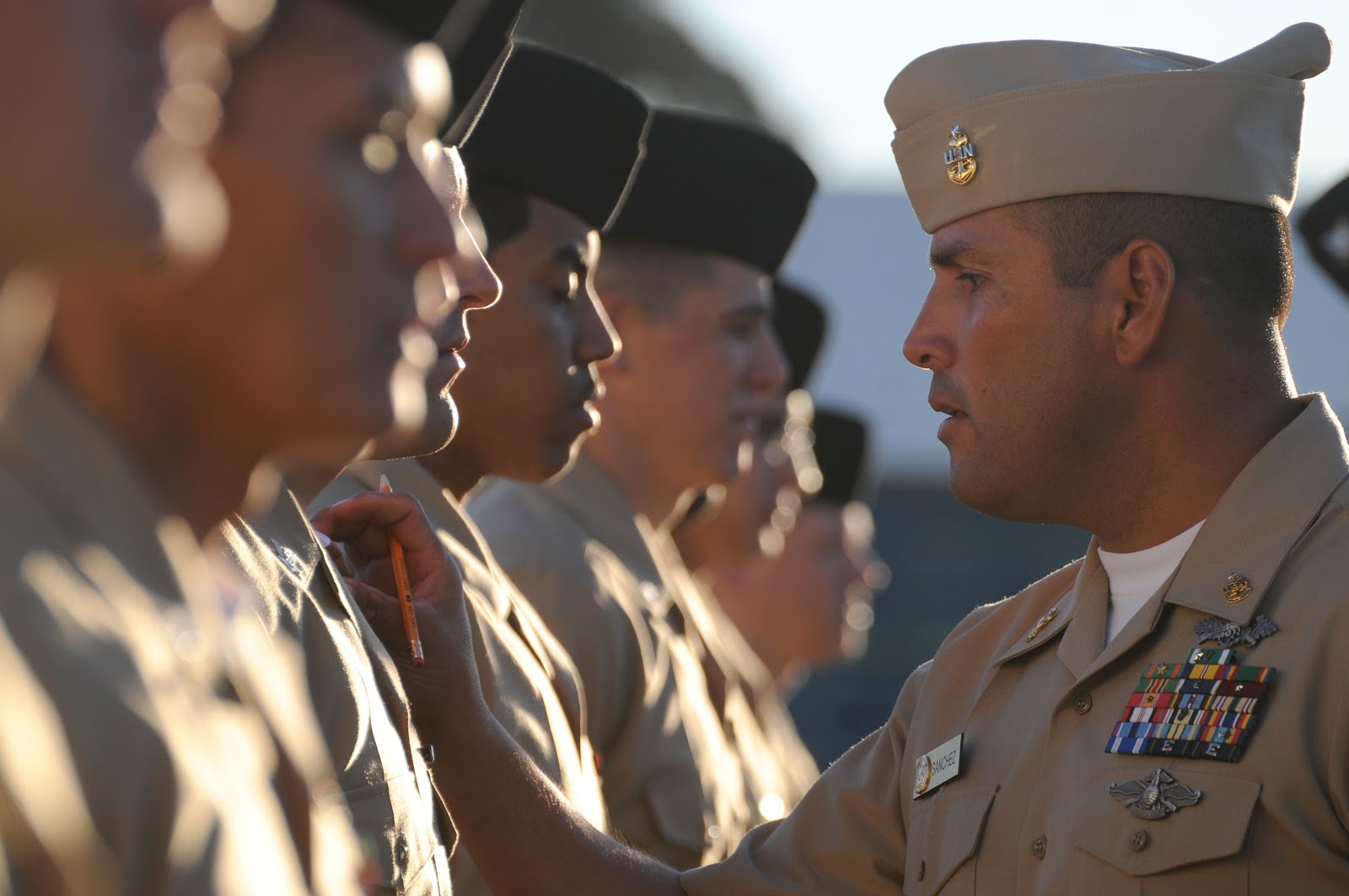
Jim Murphy – A real professional

Sailors at all levels need more than just “Zeroing in on Excellence,” but it’s a fantastic and appropriate start for the new MCPON. If taken to heart, it will go a long way toward making the best Navy better. Professional sailors will heed his words and turn them into action; amateurs will disregard his call as just another new program. As MCPON Stevens wrote, we need professionals; there is no room for amateurs. 
From Jim Murphy’s excellent article in the December issue of PROCEEDINGS magazine.  You can read it all HERE.
I have been espousing the value of Command Excellence for nearly 26 years, since my first seminar in 1986.  It’s ALL good stuff.  Nice to see the MCPON is onboard!!

Courtesy – not nearly as common as one might expect it to be

Courtesy is an act or verbal expression of consideration or respect for others. When a person acts with courtesy toward another, the courtesy is likely to be returned. We are courteous to our seniors because we are aware of their greater responsibilities and authority. We are courteous to our juniors because we are aware of their important contributions to the Navy’s mission. 
 In the military service, and particularly in the Navy where personnel live and work in close quarters, courtesy is practiced both on and off duty. Military courtesy is important to everyone in the Navy. If you know and practice military courtesy, you will make favorable impressions and display a self-assurance that will carry you through many difficult situations. Acts of respect and courtesy are required of all members of the naval service; the junior member takes the initiative, and the senior member returns the courtesy.

Teach our children

“America’s most important role in the world, almost from the day our country was born, has been the role of moral leadership…
Teach our young people to believe in the responsibility of one to another; their responsibility to God; to the people of the world. 
Teach them to believe in themselves; to believe in their worth as human beings; to believe in their place in leading the world out of the darkness of oppression. 
Teach them to believe that no one owes us a living, but that we owe so much to others. 
Teach them to believe in their priceless heritage of freedom, and that it must be won anew by every generation. 
And teach them to believe in the United States of America. 
The hope of the world lies here, in our physical power, our moral strength, our integrity, and our will to assume the responsibilities that history plainly intends us to bear.” 

Admiral Arleigh A. Burke
United States Navy
From NAVPERS 15890
Moral Leadership: The Protection of Moral Standards and Character Education Program

Say "Thank You" before it is too late

Norman B. Macintosh – “N.B.”
Recently, while facing a perplexing budget issue, I was telling a colleague of mine about a great professor who I was fortunate to have at Naval Postgraduate School, Monterey, California.  He taught an excellent course called the ‘Social Software of Financial Accounting’.  He was either a singularly impressive professor or I am suffering from an increasingly poor memory because I can’t recall another professor’s name from that time.  Norman B. “NB” Macintosh was on loan to us from Queen’s University in Canada where he was Professor Emeritus.  Dr. Macintosh received both research and teaching awards from the Canadian Academic Accounting Association during his career (“distinguished contribution to thought” and “outstanding educator,” respectively).
The conversation with my colleague brought to mind the fact that I had allowed my correspondence with “NB” (nota bene ~ meaning to ‘note well’) to lapse.  I was determined to renew my correspondence with him and send him a note of thanks for the lasting impression he made on my education and my thinking.  I searched for his address in the international 411 directory and also found him in the Queen’s University faculty directory.  I wrote my letter and searched for additional details about what he had been up to since NPS.  To my great dismay, I came across an “In Memoriam Tribute” to him on the Queen’s School of Business website from 19 May 2011.  My heart sank.  I was too late.
The lesson for me (and perhaps for you) is not to wait too long to say thanks to those who have helped expand our minds and who have demanded more of us than we thought ourselves capable.
Thank you professor N.B.