How I feel sometimes when trying to work with some of my active duty Shipmates

Artwork from http://www.hecticdesigns.co.uk.

“All at sea. “

In a state of confusion and disorder. This is an extension of the nautical phrase ‘at sea’. It dates from the days of sail when accurate navigational aids weren’t available. Any ship that was out of sight of land was in an uncertain position and in danger of becoming lost.

From my friends at SailorBob

Spotlight on a leader taking action

Note: This is the first in what I hope to make a series to periodically celebrate an action oriented leader who is walking the walk and leading regardless of his/her job title or billet description. 
Mr. Mario A Vulcano currently serves as an Instructor of the Information Warfare Basic Course at the Center for Information Dominance in Pensacola, FL. Though he has a distinguished career as CTR about which he is justifiably proud, the reason we are celebrating him is not a result of the countless significant contributions he has made over his 23 years of service in uniform (CTRSN to CTRC and ultimately CWO3) and 30 years (and counting) of total service. Today we highlight his ongoing effort to continually improve new accession training for Information Warfare Officers.
For the last five years, Mr. Vulcano has been a constant in shaping the minds of new Information Warfare Officers. He has helped to revise and deliver IW curriculum to an ever changing requirement. And though all training objectives continue to be met, he and a cadre of others have identified numerous seams in the training they are tasked to deliver. He, and others, have also grown concerned with the way such training is delivered (i.e. Death by Power Point and drinking from a firehose). Never one to look to others to fix things before doing all that he can, and firmly believing that though he might not have the authority to make things the way they ought to be, he has the responsibility to control what he can and influence what he can’t. He is currently championing the cause to weave the following mentorship opportunities into IWBC:
– IW Flag Officer engagement
– Leadership Perspectives from distinguished IW Leaders
– “Magnet” NIOC CO/XO Communication of Expectations
– Expectations of a JO – A Master Chiefs Perspective
– Community Management and Detailer Overview
– FITREP/EVAL writing 101
– Ethics, Critical Thinking and Decision Making with Capstone Case Studies
No requirement for him to do so, but feedback from students, commanding officers, and his own personal critique of the state of training give him reason to take permission and do all that he can to meet and ultimately exceed expectations. Sometimes it’s not the training solution that is the constraint. This is but a case where the training requirement is the limiting factor. Mr. Vulcano is indirectly shaping the requirement by delivering what we need beyond what was stated as a requirement. Thank-you, Shipmate.
Clearly, there are numerous action leaders serving our country, the Navy and the IDC community. I would love to feature them here so that we can all be more aware of their significant contributions, be inspired to follow their lead, and think about how we might be able to contribute to the cause they are championing. We speak of collective ownership, self-synchronizing, and taking permission. This series is about those who do more that talk the talk. Please nominate action leaders you appreciate so we can shine the spotlight on those most deserving.
Thank-you, Mario, for your leadership, personal initiative, and strong desire to make us better. May every IWO who graduates from their 8 weeks with you arrive to the Fleet ready, willing, and committed to following your example.

More awesome advice from a mentor

How to Brief a Senior Officer 
The first step is giving the boss the big picture. In a couple of sentences, try to outline the basics of the situation and the problem you seek to solve or the creative idea you are pushing.
Next, offer an assessment that lays out the key facts the decision-maker needs. Put yourself in the shoes of the decision maker and tailor the background info to what he or she doesn’t already know. You’ll need to state your assumptions up front as well.
Third step – and the key, of course – is articulating what you propose. Make this simple, creative, and sensible. Think through and discuss second order effects. Mention how your idea will play with the ‘customers’ the boss reports to as appropriate. Address the challenges – especially the resources required — in a realistic way.
Be honest and clear-eyed, not an impassioned advocate for a pet theory or project. Give both sides of the argument and anticipate objections. You need to be able to walk through the plan in such a way as to make it understandable.
Never read from a slide or a text. The decision maker doesn’t need you for that. 
Be confident, relaxed, and don’t be afraid to use a little humor as appropriate.
Realize that you will probably be asked questions you don’t know the answer to, and the only answer is “I don’t know, but I’ll find out and get back to you with the information.” Focus on outcomes.
And speak up, with good posture – as always, what we learn early in life stands us in good stead later. All of this is a skill at which you can improve with practice and observation.
If you are able, watch others as they brief senior leaders and watch the interaction. What was well received? What was poorly conveyed? What would make it better? These are “free” practice sessions for you—someone else did all the work!
Above all, be honest and work hard to convey the information—the brief is about the info, not about you. The odds are good that you’ll know more than anyone else in the room about the subject. Sharing that expertise in a brief, concise, and sensible way is the goal. Good luck!
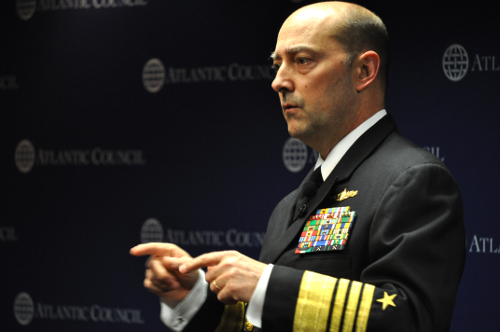
ADM James Stavridis

Thank You U.S. Navy

Sailors always remember a thank-you note, long after they forget what exactly they did to deserve it. Of course, there are the usual occasions to write thank you notes, but what are often more interesting are the unexpected ones.

A thank-you note is a gift in and of itself. Thank those Sailors for the great job they did on the Quarterdeck during the Commodore’s visit, for the great job they did at Colors this morning, Thank them for the super job they did on the engineering inspection. Thank them for keeping the Command’s 5 year safety record intact.

There are no hard-and-fast rules when it comes to writing thank-you notes. Most would prefer that you follow this rough guideline.

1. Write the thank-you note.
2. Affix stamp.
3. Mail it. I have been using this formula for 25 years or so and have yet to have one note returned.

If you are the succinct type, a correspondence card works perfectly, as does a small foldover note. Punctuality counts – and it certainly appears more sincere. Generally speaking, the message is brief and usually consists of four parts.

1. The greeting. Dear Petty Officer Smith/Lieutenant Jones.

2. An appreciation of the item or favor.

“Thank you for the the great job on the IG inspection last week.”

3. Mention how important it was.

“We couldn’t have passed without your great work.”

4. Sign off with an appreciation of their service.

“Thank you for your service in our great Navy.” That’s it. That is all there is to it.

Good intentions don’t get the job done, and while everyone intends to express a thank you, not everyone does. If your thank-you note is tardy, don’t apologize for being late. You know you are late, and the person you are writing knows it. Just get on with it.

Adapted from Crane’s Guidance on Correspondence

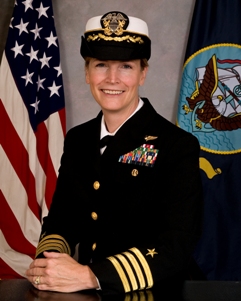
"Clutch" Commander Carrier Air Wing THREE

Captain Sara “Clutch” Joyner, a native of Maryland, received her commission in 1989 graduating with merit from the United States Naval Academy with a Bachelor of Science degree in Oceanography. After graduation, she attended flight school and earned her Naval Aviator wings in July 1991 from VT-24 in Beeville, Texas. After completing flight training, Captain Joyner reported to VC-5, the “Checkertails,” in Cubi Point, Philippines to fly the A-4E Skyhawk. In May of 1992, due to the imminent closure of Cubi Point, she was assigned to VC-8, the “Redtails,” in Roosevelt Roads, Puerto Rico.
Captain Joyner reported to COMSTRKFIGHTWINGPAC in Lemoore, California in November of 1994 as Assistant Operations Officer. She subsequently received a transition to the F/A-18 Hornet and reported to VFA-125, the “Rough Raiders,” for training in October of 1996.
Upon completion of her training as a Hornet Pilot, she reported to VFA-147, the “Argonauts,” in May of 1997. Remaining with VFA-147 for both her Junior Officer and Department Head tours, she completed two Western Pacific Cruises to the Arabian Gulf aboard USS NIMITZ (CVN 68) in September of 1997 and USS JOHN C. STENNIS (CVN 74) in September of 1999 in support of Operation SOUTHERN WATCH. In November of 2001, she again deployed with VFA-147 aboard USS JOHN C. STENNIS in support of Operation ENDURING FREEDOM. During her tour at VFA-147, she served in many capacities, including the Department Head in Maintenance, Operations, and Safety. 
In January 2002, she reported to United States Joint Forces Command, Norfolk, Virginia where she served in the Current Operations Branch as Force Deployment Officer for the NORTHCOM, EUCOM, and CENTCOM Areas of Responsibility in support of Operations ENDURING FREEDOM and IRAQI FREEDOM. She reported to VFA-105 in November of 2006 as Executive Officer.  
In March 2007, Captain Joyner assumed command of VFA-105. On 2 November 2007, she led the Gunslingers on their combat cruise to the Persian Gulf in support of Operation Iraqi Freedom. Under her leadership the squadron performed nearly 2,000 combat missions totaling over 4,900 flight hours and delivering 35,000 pounds of ordnance in support of coalition ground forces in Iraq.  
Captain Joyner recently completed her tour at OPNAV N88 as the Joint Strike Fighter Requirements officer responsible for bringing the next generation of carrier strike aircraft to the fleet. 
Lots of AWESOMENESS in there.  All GO and not too much show.