What I am working on today – unlearning

I consider myself to be a lifelong learner.  I can never read enough or write enough to suit myself.  I love learning new things.  But I’ve had some difficulty with unlearning.  One of the most profound and commonly overlooked aspects of my quest for new learning has been my recognizing the need to  unlearn some things. Over 30 years in the Navy, I acquired knowledge, beliefs or positions that but for the protection of my own ego, I would have to admit are outdated and “old school”.
Sometimes, the hardest thing for me to change has been my own mind.  I know that smart Navy leaders recognize it’s much more valuable to step across mental rhumblines on a chart than to draw them. Here’s the deal: None of us has all the answers, so why even attempt to pretend that we do? Show me a Navy leader that never changes their mind, and I’ll show you a static thinker who has confined his mind to the correctional custody unit (CCU) of mediocrity and thoroughly wasted potential.
Some of the smartest Sailors I know are the most willing to change their minds. They don’t have to be right every time, they just want the right outcome — they want to learn, grow, develop, and mature – and take as many other Sailors on the journey with them. Exposing yourself to alternate opinions allows you to refine your good ideas, weed out the bad ideas and acquire new ideas.
A Navy leader’s ability to change their mind demonstrates humility, confidence and maturity. It makes them approachable, and it makes them human. Our Sailors are looking for authentic, leaders who are willing to sacrifice their ego (collar devices) in favor of right thinking.
Hang on, I think I just changed my mind.

CSAF – General Mark Welsh

Mark Welsh – All around good guy!!
The new Chief of Staff of the Air Force is a leadership force to be reckoned with.  He is a great speaker and really connects with his audience.  HERE is an hour long speech his gave at the U.S. Air Force Academy.

Here are a few key points:
  • You better be willing to make decisions. Sometimes without all the information you want. Get ready.
  • You better be good. ‘Your job is to lead them… are you ready?”
  • You must make a difference.
  •  We are a team. All the people are important. (Though not equally important.)
  •  Attention to detail is it important. You better have it.
  •  Leadership is a gift given by those who follow.  (Don’t abuse the gift or take it for granted.)
  •  Are you ready to lead? If not, rededicate yourself to the effort. (Still not ready to lead, get out of the way.)

Responsibility of the Commanding Officer – Chapter 8 – U.S. Navy Regulations 1990

0802. Responsibility.

1. The responsibility of the commanding officer for his or her command is absolute, except when, and to the extent to which, he or she has been relieved therefrom by competent authority, or as provided otherwise in these regulations. The authority of the commanding officer is commensurate with his or her responsibility. While the commanding oflicer may, at his or her discretion, and when not contrary to law or regulations, delegate authority to subordinates for the execution of details, such delegation or authority shall in no way relieve the commanding officer of continued responsibility for the safety, well-being and efficiency of the entire command.

2. A commanding officer who departs from orders or instructions, or takes official action which is not in accordance with such orders or instructions, does so upon his or her own responsibility and shall report immediately the circumstances to the officer from whom the prior orders or instructions were received. Of particular importance is the commanding officer’s duty to take all necessary and appropriate action in self-defense of the command.

3. The commanding officer shall be responsible for economy within his or her command. To this end the commanding officer shall require from his or her subordinates a rigid compliance with the regulations governing the receipt, accounting and expenditure of public money and materials, and the implementation of improved management techniques and procedures.

4. The commanding officer and his or her subordinates shall exercise leadership through personal example, moral responsibility and judicious attention to the welfare or persons under their control or supervision. Such leadership shall be exercised in order to achieve a positive, dominant influence on the performance of persons in the Department of the Navy.

Naval Regulations Chapter 8 – The Commanding Officer

Sixteenth Navy Commanding Officer fired

The commanding officer and command master chief of Helicopter Mine Countermeasures Squadron FIFTEEN were fired on 1 September after two accidents in the Middle East, including one that killed two squadron Sailors.

Commander Sara Santoski was fired for a “loss of confidence” in her ability to command.

She was fired by Captain Paul Esposito, commander of Helicopter Sea Combat Wing Atlantic. She has been reassigned to AIRLANT’s staff.

HM-15’s Command Master Chief, Bobby Anderson, also was fired because of “unsatisfactory performance.” He was the 11th senior enlisted leader fired this year.

Leader – lead thyself

Put it on paper! Write out your personal and professional goals with clear targets. Read them once a week. Are your day-to-day actions aligned with your values, your standards, your philosophy of leading? (Have you expressly stated your values, standards and philosophy??)What are your boundaries? (Not everything is black and white. Be careful as you venture into the gray areas. Plan for the gray.) Do you take measures to protect them? If your answers to these questions are negative, what is causing this? What insight does this give you? Use this information as a means to spur yourself to action rather than complacency and inaction.  Develop that bias for action you know you need to succeed.

“It is not only what we do, but also what we do not do, 
for which we are accountable.” 
Jean Baptiste de Poquelin

What is it that you are avoiding doing that really must be done? For example, are you putting off that difficult conversation with your Skipper about his womanizing and his excessive use of alcohol? Are you delaying that important decision about your Sailors’ nomination for Limited Duty Officer? Are you delegating away uncomfortable responsibilities that really belong in your court?  You are as responsible for the things that you don’t do in exactly the same way that you are accountable for the things you do.  Take action now while you have a chance to change things for the better.  Tomorrow may be too late.  Next week certainly will be.  And don’t even think about waiting until next month.  DO IT NOW.

Leader, lead thyself.

15th Navy Commanding Officer Fired

Commander Martin Arriola at sea.
Earlier today Rear Admiral David Thomas fired Commander Martin Arriola following the USS PORTER’s collision with a Japanese oil tanker earlier this month just outside the Strait of Hormuz.  This is not a surprise as the  Commander, Naval Surface Force Atlantic was awaiting results of the official investigation of the collision to be concluded.  Rear Admiral Thomas reassigned Commander Arriola to the staff of Naval Surface Force Atlantic because of his loss of confidence in Commander Arriola’s ability to command.
Commander Dave Richardson is the new commanding officer of USS PORTER.

Character – a reflection of a man’s grip upon himself

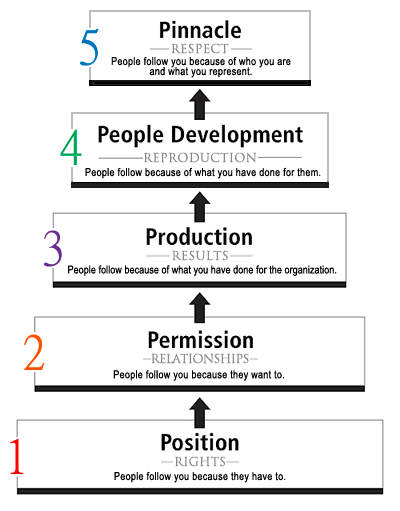
John Maxwell’s 5 Levels of Leadership

Assuming that there are three officers each of whom respects, and is respected, by a group of men, what qualities will one possess that will inspire the men to look upon him as their leader? They will lean toward the one officer possessing the strongest character. By character is meant integrity, courage, morality, humility, and unswerving determination. Character is a spiritual force. It is a reflection of a man’s grip upon himself, the degree to which he is able to dominate the baser instincts that beset us all.

Because men know that the conquest of one’s own weaknesses is a far, far more difficult task than any other, they tend to believe that he who can conquer himself, can also conquer whatever problem is at hand. That is why, in civilian life, the masses look to a man of character to lead them.

Your first job, then, is to learn to know your own weaknesses and conquer them. Our fears are a key to our weakness, because we fear only the things which we feel we cannot do well. We all have fears. Force yourself to conquer and to face squarely every situation you are afraid to meet. It is not being afraid but running away that weakens character. When you have accomplished this, you will have developed character. 

RADM Harley Cope
Navy Cross 1941

Some Don’ts for junior officers

Don’t take a man to task in front of his juniors.  It humiliates him and arouses a feeling of resentment.  Censure in private.

Don’t criticize the orders given to your division.

Don’t criticize or belittle your ship, the Skipper, or any of the officers, ever.

Don’t permit juniors to make such criticisms in your presence.  Teach them, as well as yourself, if you don’t like something, to work hard to improve it.  Don’t tear down.  Build up.

Don’t use filthy or obscene language.  Don’t let men use it in your presence.  People who use such language simply prove that they are unable to express themselves otherwise.

THE NAVAL OFFICER’S MANUAL
RADM Harley Cope (USNA ’20)
July 1951

Congratulations to these superstar IW leaders

IW O6 Command
SHAUL FRANK ALBERT                    

ELAM DONALD EMMET                  

SCHEIDT JEFFREY S                           
BERG HEIDI KRISTEN                      
STEWART ANDREW DONALD        
IW O5 Command               
SLATTERY CHRISTOPHER PAUL    
FRANKLIN CLARENCE JR                
ELLIOT MICHAEL CHARLTON        
LIND RACHEL JOY VELASCO          
RATKUS MARC W                               
BRYANT CHRISTOPHER GLEN        
IW O5 Milestone               
BOWMAN STACY A                            
DROTAR JOHN RONALD                    
SUH ROBERT JOON                             
CAVER LEONARD WAYNE              
WOODCOCK NORMAN B  
WEECH CHRISTOPHER A        
LOCK KEVIN R                        
LOVELLO DOMINIC R                
DANIELS WILLIAM A                  

CHIPS interview with Captain Susan K. Cerovsky, CO Center for Information Dominance

Capt. Susan K. Cervosky was selected for lateral transfer to the Information Warfare community in 2003 and was reassigned to Naval Network Warfare Command where she worked computer network defense initiatives. In May 2005, she reported as executive officer to the Navy Cyber Defense Operations Command (NCDOC). Next, she was the executive assistant to the Commander, Naval Network Warfare Command and most recently served as the Joint Forces Command J2 Chief of Staff from June 2010 until September 2011 prior to reporting to the Center for Information Dominance. Cerovsky became commanding officer of CID in October 2011. 
The Center for Information Dominance, based at Corry Station, in Pensacola, Fla., is the Navy’s learning center that leads, manages and delivers Navy and joint force training in information operations, information warfare, information technology, cryptology and intelligence. The CID domain comprises nearly 1,300 military, civilian and contracted personnel; CID oversees the development and administration of more than 223 courses at four commands, two detachments and 16 learning sites throughout the United States and in Japan. CID provides training for approximately 24,000 members of the U.S. Armed Services and allied forces each year.
  • Q: You’ve been the commanding officer of CID since October 2011 — what is your overall impression of the job? 
  • Q: The mission of the Center for Information Dominance is “to deliver full spectrum Cyber Information Warfare, and Intelligence Training to achieve decision superiority.” Can you explain what this means? 
  • Q: What sort of skills or background would a person need if they were thinking of becoming a cryptologic technician (CT), information systems technician (IT) or intelligence specialist (IS)? 
  • Q: Approximately how many students (officers and enlisted) are trained at CID annually? 
  • Q: CID is headquartered at Corry Station in Pensacola, Fla., but the domain is large. Can you elaborate on what rates and curriculum fall under CID? 
  • Q: What does the merger of Center for Naval Intelligence (CNI) and CID mean for CID; for the Navy? 
  • Q: What is the significance of the IDC and do you think it will change the way CID operates? 
  • Q: Technology is changing so quickly, how does the Navy update its training to keep pace? 
  • Q: How often do you perform HPRRs and what happens to all the data created during the HPRR? 
  • Q: What role do you think CID will play in the future for the Navy?

Her answers are available HERE in CHIPS Magazine.