Navy Makes A Major Push To Defend Its Cyberspace

Captain Bryan Lopez
Newly Formed Units Bring Computer Savvy To The Information War.


With reports of China and Russia trying to slip into the Pentagon’s information networks on a daily basis, U.S. security experts now rank the military threat from cyberspace just behind terrorism and nuclear proliferation.
In that atmosphere, the people whose domain has been the cubicle and the computer room are getting a chance to be recognized as “warriors,” on par with those who shoot guns and fly fighter jets.
Since 2010, the U.S. military has moved to erect barricades against attacks in cyberspace, including the creation of U.S. Cyber Command at Fort Meade, Md., to lead the effort.
The Navy re-established the World War II-era 10th Fleet as its piece of the cyber effort in early 2010. A few months earlier, it took another step that may have far-reaching significance.
Naval leadership created an “information dominance” corps that is bucking for equal standing with the Navy’s traditional “war-fighters” — aviators, submariners and Sailors on surface ships.
It used to be that the Navy’s weather experts, computer operators, intelligence analysts and cryptologists — the service’s “geek squad,” some might say — were assigned to a windowless room in the middle of the ship or the back of the airplane.
Aside from securing military computer networks against hackers, exactly how the military’s forces are waging war in cyberspace remains hush-hush. But late last year, defense officials revealed to Congress that the Pentagon has the ability to go on the offense in cyberspace.
Just as aviators earn gold wings, these “cyber warriors” are eligible for a newly created insignia. They must study aspects of all the information-centric jobs in order to earn it. Hence, the idea of creating a “corps.”
While it may sound trivial, it’s a big deal in the tradition-heavy Navy. Sailors are proud of their surface warfare pins that show a ship with crossed swords. Submariners earn insignia that depicts a diving ship. The information dominance version bears a lightning bolt crossed with a sword.
As of last month, 4,647 naval officers and 1,612 enlisted Sailors have qualified for the new warfare pin, a Navy spokesman said. Roughly 12,000 Navy service members are assigned to 10th Fleet operations — most from the information dominance corps. They are spread out around the world, including at the Navy Information Operations Command San Diego at North Island Naval Air Station.
Separately, Navy personnel at a wide spectrum of commands do related work, such as intelligence officers on ships and meteorologists at aircraft squadrons. They, too, are considered part of the Navy’s information dominance corps.
Analysts say that U.S. military networks are being probed constantly, often by automated fishing programs, with varying degrees of success.
In the Navy, there’s been some elbow-throwing about the new information “dominators,” as some quipsters have dubbed them. A Navy Times cartoonist penned a caricature of the cyber pin wearing taped-together geek glasses.
Some analysts credit the Navy for carving out more of a career path for the information specialties. A plan to have senior-level people cross train — an intelligence officer serving in a job normally filled by someone with a cryptology background — should produce leaders with broader knowledge and help upward mobility and retention.
“Navy has been kind of the leader in thinking about how to do this thing,” said Lewis of CSIS.
Capt. Bryan Lopez has served 25 years in the Navy after starting as an enlisted cryptologist. Now he’s the executive officer at Point Loma’s Space and Naval Warfare Systems Center Pacific.
He wears the information dominance pin, and he’s heard the criticism.
“There might be an opinion among the older generation: ‘You guys are looking for an excuse to justify yourselves.’ I would say that’s shortsighted. I would also say, you’re living in the past,” Lopez said. “I would say even people in my generation don’t have a good grip on the vulnerabilities and the potential ramifications of attacks that are happening today.”
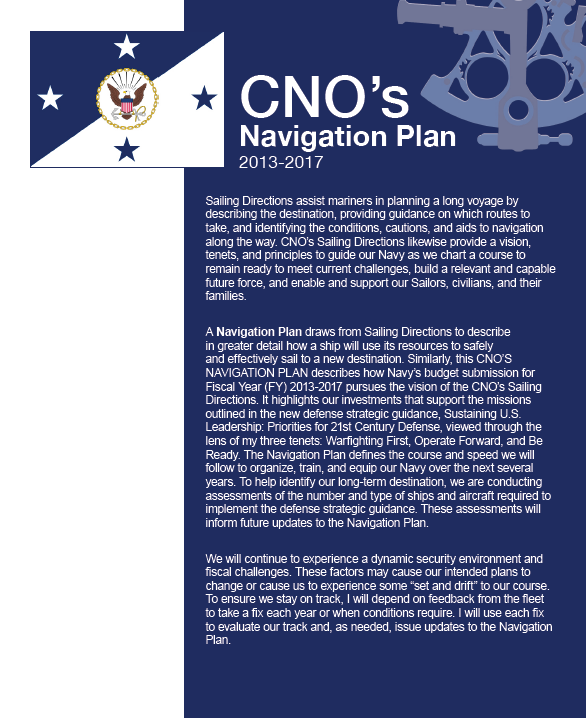
Note for Commanding Officers

 
“I expect this plan to be a priority for everyone and communicated at all levels, to help ensure we reach its objectives together.”

Admiral Jonathan Greenert
Chief of Naval Operations

 Full Navigation Plan is HERE

What are you doing to make sure the CNO’s plan is communicated to your Sailors??

General Patton’s view of the ‘staff officer’

The typical staff officer is a man past middle life, spare, wrinkled, intelligent, cold, noncommittal, with eyes like a codfish, polite in contact, but at the same time unresponsive, cool, calm and as damnably composed as a concrete post or plaster of Paris cast; a human petrification with a heart of feldspar and without charm or the friendly germ; minus bowels, passions or a sense of humor.
Happily they never reproduce and all of them finally go to hell.

Gen George S. Patton, Jr.

Remembering the shootdown of Deep Sea 129

Flight of Deep Sea 129

Beggar Shadow mission

At 07:00 local time of Tuesday, 15 April 1969, an EC-121M of the U.S. Navy’s Fleet Airborne Reconnaissance Squadron One took off from Atsugi, on an intelligence-gathering reconnaissance mission.

The aircraft, Bureau number 135749, c/n 4316, bore the tail code “PR-21” and used the radio call sign Deep Sea 129. Aboard were 8 officers and 23 enlisted men under the command of LCDR James Overstreet. Nine of the crew, including one Marine were Naval Security Group cryptologic technicians (CTs) and linguists in Russian and Korean.

Deep Sea 129’s assigned task was a routine Beggar Shadow signal intelligence (SIGINT) collection mission. Its flight profile northwest over the Sea of Japan took it to an area offshore of Musu Point, where the EC-121M would turn northeast toward the Soviet Union and orbit along a 120-nautical-mile (222 km) long elliptical track. These missions, while nominally under the command of Seventh Fleet and CINCPAC, were actually controlled operationally by the Naval Security Group detachment at NSF Kamiseya, Japan, under the direction of the National Security Agency.

LCDR Overstreet’s orders included a prohibition from approaching closer than 50 nautical miles (90 km) to the North Korean coast. VQ-1 had flown the route and orbit for two years, and the mission had been graded as being of “minimal risk.” During the first three months of 1969 nearly 200 similar missions had been flown by both Navy and U.S. Air Force reconnaissance aircraft off North Korea’s east coast without incident.

The mission was tracked by a series of security agencies within the Department of Defense that were pre-briefed on the mission, including land-based Air Force radars in Japan and South Korea. The USAF 6918th Security Squadron at Hakata Air Station, USAF 6988th Security Squadron at Yokota Air Base, and Detachment 1, 6922nd Security Wing at Osan Air Base monitored the North Korean reaction by intercepting its air defense search radar transmissions. The Army Security Agency communications interception station at Osan listened to North Korean air defense radio traffic, and the Naval Security Group at Kamiseya, which provided the seven of the nine CTs aboard Deep Sea 129, also intercepted Soviet Air Force search radars.

At 12:34 local time, roughly six hours into the mission, the Army Security Agency and radars in Korea detected the takeoff of two North Korean Air Force MiG-17s and tracked them, assuming that they were responding in some fashion to the mission of Deep Sea 129. In the meantime the EC-121 filed a scheduled activity report by radio on time at 13:00 and did not indicate anything out of the ordinary. 22 minutes later the radars lost the picture of the MiGs and did not reacquire it until 13:37, closing with Deep Sea 129 for a probable intercept.

The communications that this activity generated within the National Security network was monitored by the EC-121’s parent unit, VQ-1, which at 13:44 sent Deep Sea 129 a “Condition 3” alert by radio, indicating it might be under attack. LCDR Overstreet acknowledged the warning and complied with procedures to abort the mission and return to base. At 13:47 the radar tracks of the MiGs merged with that of Deep Sea 129, which disappeared from the radar picture two minutes later.

At first none of the agencies were alarmed, since procedures also dictated that the EC-121 rapidly descend below radar coverage, and Overstreet had not transmitted that he was under attack. However when it did not reappear within ten minutes, VQ-1 requested a scramble of two Air Force Convair F-102A Delta Dart interceptors to provide combat air patrol for the EC-121.

By 14:20 the Army Security Agency post had become increasingly concerned. It first sent a FLASH message (a high priority intelligence message to be sent within six minutes) indicating that Deep Sea 129 had disappeared, and then at 14:44, an hour after the shoot-down, sent a CRITIC (“critical intelligence”) message (the highest message priority, to be processed and sent within two minutes) to six addressees within the National Command Authority, including President Richard M. Nixon and National Security Advisor Henry Kissinger.

A search and rescue effort was immediately launched by VQ-1 using aircraft of both the U.S. Air Force and Navy. The first response was by an Air Force Lockheed HC-130 Hercules, with a Boeing KC-135A Stratotanker tanker in support and an escort of fighters, but the search effort rapidly expanded to a total of 26 aircraft. At short notice, two U.S. Navy destroyers, USS Henry W. Tucker and USS Dale, sailed from Sasebo, Japan, on the afternoon of April 15 toward the area of last contact (41°2800N 131°3500E / 41.4666667°N 131.5833333°E), a position approximately 90 nautical miles (167 km) off the North Korean port of Ch’ŏngjin.

The first debris sighting occurred at 09:30 the next morning, 16 April, by a Navy VP-40 P-3B Orion aircraft. Two destroyers of the Soviet Navy #429 Kotlin Class and #580 Kashin Class were directed to the scene by the Navy aircraft. The Air Force HC-130 SAR aircraft, that relieved the P-3B, dropped the Soviet ships URC-10 survival radios and eventually made voice contact in the afternoon as the Soviet craft were departing. Both Soviet ships indicated they had recovered debris from the aircraft but had not found any indication of survivors. That evening Tucker arrived in the area and after midnight recovered part of the aircraft perforated with shrapnel damage.

At approximately noon of 17 April Tucker recovered the first of two crewmen’s bodies, then rendezvoused with the Soviet destroyer Vdokhnovenny (D-429) and sent over her whaleboat. The Soviets turned over all of the debris they had collected. The bodies of Lt.j.g. Joseph R. Ribar and AT1 Richard E. Sweeney were taken to Japan but those of the other 29 crewmen were not recovered.

North Korea publicly announced that it had shot down the plane, claiming it had violated its territorial airspace. The U.S. government acknowledged that it was conducting a search for a missing aircraft but stated that it had explicit orders to remain at least 50 nautical miles (93 km) offshore. Of note, April 15 was the 57th birthday of the North Korean dictator Kim Il-Sung.

From WIKIPEDIA

Those lost include:

Lcdr. James H. Overstreet,
Lt. John N. Dzema,
Lt. Dennis B. Gleason,
Lt. Peter P. Perrottey,
Lt. John H. Singer,
Lt. Robert F. Taylor,
Ltjg. Joseph R. Ribar,
Ltjg. Robert J. Sykora,
Ltjg. Norman E. Wilkerson,
ADRC Marshall H. McNamara,
CTC Frederick A. Randall,
CTC Richard E. Smith,
AT1 Richard E. Sweeney,
AT1 James Leroy Roach,
CT1 John H. Potts,
ADR1 Ballard F. Conners,
AT1 Stephen C. Chartier,
AT1 Bernie J. Colgin,
ADR2 Louis F. Balderman,
ATR2 Dennis J. Horrigan,
ATN2 Richard H. Kincaid,
ATR2 Timothy H. McNeil,
CT2 Stephen J. Tesmer,
ATN3 David M. Willis,
CT3 Philip D. Sundby,
AMS3 Richard T. Prindle,
CT3 John A. Miller,
AE3 LaVerne A. Greiner,
ATN3 Gene K. Graham,
CT3 Gary R. DuCharme,
SSGT Hugh M. Lynch,(US Marine Corps).
 
REST IN PEACE

Peter Munson, USMC on Disruptive Thinkers

Disruptive thinkers are not a threat to good order and discipline, nor to mission accomplishment. Disruptive non-thinkers, on the other hand, are. We are in for times far more challenging than most of our force can currently foresee. In order to find success, we will have to encourage disruptive thinking to spur innovation from the bottom up. This will never happen, however, if we do not get the coming transition right by empowering the right change leaders to think and act disruptively to change our organizational structure and culture from the top down.

Read his entire piece at Small Wars Journal HERE.

In case you missed it…like I did

In a Change of Command ceremony rich in Navy tradition, Captain Kathryn M. Helms was relieved as Commander, National Security Agency/Central Security Service (NSA/CSS) Hawaii by Captain David Carson on 30 March 2012.  Captain Helms retired from the Navy.  She was previously the Senior Information Warfare Officer Detailer, CO of Navy Information Operations Command Denver and served on the Commander, SEVENTH Fleet staff embarked in USS BLUE RIDGE (LCC 19) in Yokosuka Japan.

Fair winds and following seas !