Secretary of Defense Robert Gates announced this afternoon that Admiral Greenert would be the next Chief of Naval Operations

Admiral Jonathan W. Greenert

Adm. Jonathan W. Greenert is a native of Butler, Penn. He graduated from the U.S. Naval Academy in 1975 and completed studies in nuclear power for service as a submarine officer.

His career as a submariner includes assignments aboard USS Flying Fish (SSN 673), USS Tautog (SSN 639), Submarine NR-1 and USS Michigan (SSBN 727 – Gold Crew), culminating in command of USS Honolulu (SSN 718) from March 1991 to July 1993.

Subsequent fleet command assignments include Commander, Submarine Squadron 11, Commander, U.S. Naval Forces Marianas, Commander, U.S. 7th Fleet (August 2004 to September 2006) and Commander, U.S. Fleet Forces Command (September 2007 to July 2009).

Greenert has served in various fleet support and financial management positions, including deputy chief of naval operations for integration of capabilities and resources (N8); deputy commander, U.S. Pacific Fleet; chief of staff, U.S. 7th Fleet; head, Navy Programming Branch and director, Operations Division Navy Comptroller.

He is a recipient of various personal, and campaign awards including the Distinguished Service Medal (5 awards), Defense Superior Service Medal and Legion of Merit (4 awards). In 1992 he was awarded the Vice Admiral Stockdale Award for inspirational leadership. He considers those awards earned throughout his career associated with unit performance to be most satisfying and representative of naval service.

I am hearing that LCDR Matt Tucker’s Detachment For Cause (DFC) has been reversed by the Board for Correction of Naval Records (BCNR)

In a rather unusual move, I have heard that Captain Hospodar’s decision to fire LCDR Matt Tucker has been reversed by the BCNR.
I am waiting additional facts/information.

Original NAVY TIMES story is below.

Philip Ewing – Staff writer
Wednesday Mar 4, 2009

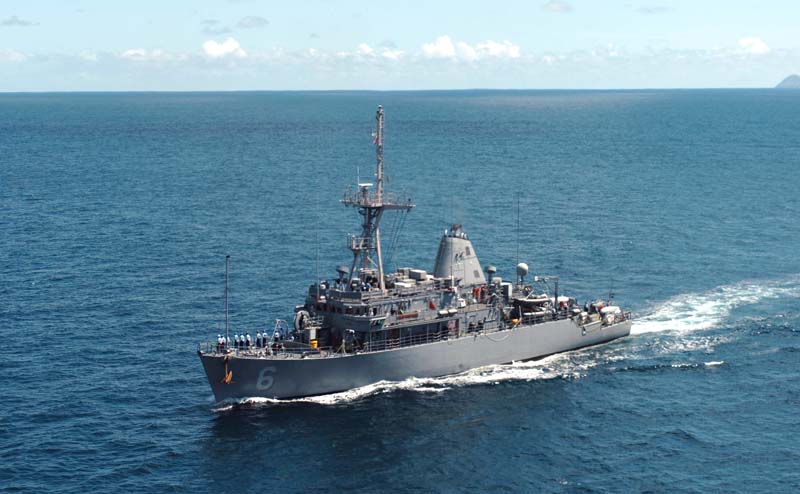
The commanding officer of the mine countermeasures ship Devastator was relieved of command Tuesday for not “maintaining ship readiness standards,” the Navy announced.

Lt. Cmdr. Matt Tucker, who commanded the crew Persistent, was relieved by the commander of Mine Countermeasures Squadron 2, Capt. Robert Hospodar, just over three weeks after Naval Station Ingleside, Texas-based Devastator underwent a scheduled examination by the Board of Inspection and Survey (INSURV).

The chief staff officer for the squadron, Cmdr. Angel Cruz, took command of the Devastator and will stay as CO until Friday. Then he is to yield command of the ship to Lt. Cmdr. Thomas Shear, the current executive officer of the mine countermeasures ship Chief, a sibling of the Devastator.

A spokesman for Naval Mine and Anti-Submarine Warfare Command did not have information about where Tucker had been assigned after his relief.

Tucker took command of the Devastator’s crew Persistent Nov. 25, after having served as executive officer of the mine countermeasure ship Scout in Bahrain.

Captain Joseph J. Rochefort Information Warfare Officer (IWO) Distinguished Leadership Award

The first set of nominees for the annual Captain Rochefort Information Warfare (IW) Officer Distinguished Leadership Award is being reviewed by a distinguished group of Information Warfare community Captains. The purpose of the “peer nomination award” is to recognize the superior career achievement of one Information Warfare Officer each year beginning in 2011.  An announcement of the winner is expected soon.  Plans originally called for the selectee to be announced during the Navy’s observance/commemoration of the Battle of Midway. 

In the spirit of teamwork and selflessness show by Captain Joseph J. Rochefort, specific consideration is given to leadership, teamwork, operational considerations, and adherence to the principle by which he served:

“We can accomplish anything provided no one cares who gets the credit.”

Representing the best of the intelligence and cryptologic communities, Rochefort was driven but unflamboyant. Rising from the enlisted ranks, he was an outsider to the elite fraternity of officers who had graduated from the Naval Academy. He was a conventional career Sailor who had pursued a conventional career path: sea duty, engineering school, ensign’s commission, more sea duty.  Rochefort spent FOURTEEN years at sea !

His record of achievement in the intelligence and cryptologic communities is remarkable, yet he considered himself somewhat of a failure.

“I can offer a lot of excuses,” he would later say, “but we failed in our job. An intelligence officer has one job, one task, one mission — to tell his commander, his superior, today what the Japanese are going to do tomorrow.”

His humility was disarming.

Navy Begins Routine Cybersecurity Inspections of 900 commands – on 36 month cycle

According to Naval Network Warfare Command’s retiring commander, RADM Ned Deets, the Navy is preparing for “stem to stern” inspections in cybersecurity. This will involve a regime of inspections focused specifically on IT security.
“We’ve never had an inspection force (for cybersecurity). We do now—nascent, but growing.  We’ve built an inspection plan that will eventually inspect, on a three year cycle, 900 command units across the Navy. It looks a lot like a lot of the other inspection programs we have across the Navy, like INSURV and things of that nature”, RADM Deets said.
Each year every one of the 900 commands should expect to be subjected to some sort of cybersecurity inspection. 
“We’ll do an administrative inspection to take a look at your program first (year).  Second (year) will be unit-level training and advice and assistance to ensure that you’re ready to operate in your unit, and third (year) will be a stem-to-stern inspection of everything associated with your networks and long-haul communications, physical security included. In the Navy, we expect what we inspect, and we have never inspected in this area before,”  RADM Deets continued.

“The network security posture is still not on a lot of commanders’ daily reports, and it really needs to be,” Admiral Greenert said. “The workforce awareness is pretty low on information assurance. We still need to go in and slap people’s hands, because they want to plug things like thumb drive into our computers or they want to charge their iPads. We’re not really complying yet with the existing security directives, and up to nine out of ten of the exploits that we’ve had have been known vulnerabilities. They could have been cut off.”
RADM Deets said the Navy lacks the ability to oversee and defend its networks to the degree it would like to, in part, because there are so many of them. 
You can listen HERE. It’s a good interview.

Navy Chiefs – A Post Worth Repeating – Command Excellence in the CPO Mess

“The backbone of the Navy” is how one old adage sums up the importance of the Chiefs quarters. Superior commands are especially quick to acknowledge the Chief Petty Officer’s special role and contribution. The uniqueness of that role is a function both of the position the Chief occupies in the organizational structure and of the job qualifications that must be satisfied before the position is attained. Chiefs have considerable managerial and technical expertise and are the linchpin between officers and enlisted.
For there to be a strong Chiefs quarters, the Chiefs must feel that they are valued and that they have the authority and responsibility to do the job the way they think it ought to be done. In superior commands, the Chiefs feel that their special leadership role is sanctioned and appreciated by the rest of the command, especially the CO. In these commands, the Chiefs are included in all major activities, particularly planning. Their input is sought and readily given. If they believe that something won’t work or that there is a better way to do it, they speak up.
Chiefs in superior commands lead by taking responsibility for their division. They motivate their subordinates, counsel them, defend them when unjustly criticized, monitor and enforce standards, give positive and negative feedback, communicate essential information, solicit input, monitor morale, and take initiative to propose new solutions and to do things before being told.
The Chiefs play a key role in the enforcement of standards. Because they are out and about, they see for themselves whether job performance and military bearing meet the Navy’s and the command’s requirements.
When work is done well, they offer recognition and rewards; when it is done poorly, they act to correct it. They also know the importance of modeling the kind of behavior they expect their people to display. If they expect their personnel to work long hours to get something done, they work the same hours right along with them. Their concerns extend beyond their immediate areas, however.
Chiefs in superior commands act for command-wide effectiveness, promoting the success of the unit as a whole. Although they have a strong sense of ownership and take responsibility for their division’s activities, they are able to look beyond the job at hand: when other departments or divisions need assistance, chiefs in superior commands are willing to help.

The superior Chiefs quarters usually has a strong leader who plays the role of standard-bearer for the command, creates enthusiasm, offers encouragement, and drives others to excel. It is usually someone whom the other chiefs perceive as fair, who stands up for their interests and those of the crew, who listens with an open mind, and who has demonstrated a high degree of technical proficiency.

In superior commands, the Chiefs quarters functions as a tight-knit team. The Chiefs coordinate well, seek inputs from each other, help with personal problems, identify with the command’s philosophy and goals, and treat each other with professional respect.
Finally, this ability to perceive larger goals and to work toward them as a team extends to their relationships with division officers. Chiefs in superior commands are sensitive to the difficulties that arise for division officers, who lack experience and technical know-how but must nevertheless take their place as leaders within the chain of command. A superior Chiefs quarters supports and advises these new officers fully and tactfully.
CNO – Ignoring social media is a ‘strategic error of the most basic nature’

“When you empower your workforce to be communicators, you must understand that you won’t always agree with what they say or perhaps how they say it. You can certainly set reasonable boundaries–we tell our Sailors not to disclose classified information, and we expect everyone to treat everyone else with dignity and respect. But you can’t dictate everything your people say,” said Admiral Gary Roughead.
By having junior officers maintain blogs and Facebook pages, communities have grown to better support one another–helping to address attrition and retention problems, the CNO said.

The Chief of Naval Operations comments are HERE.

Note:  Recall that in 2008, the Information Warfare Officer Community Manager (IWOCM) blog was shut down by RADM Ned Deets (NNWC) via Captain Will Metts (Senior IW Detailer).  It may be time to bring it back!!  With the CNO’s support.

More of Jeff Bacon’s humor is available HERE.

RADM Card in the fight

In November 2008, USMC Lieutenant Colonel Andy Kostic, the commanding officer of the 26th MEU – Marine Expeditionary Unit’s Battalion Landing Team 2/6, shows Rear Admiral Kendall Card, Expeditionary Strike Group 3, an 81mm round. The 26th MEU was deployed with the IWO JIMA Strike Group in the Persian Gulf supporting security and stability operations.
Now a Vice Admiral, Kendall Card is the second admiral to serve as Deputy Chief of Naval Operations for Information Dominance and the 64th Director of Naval Intelligence (N2N6) on the OPNAV staff.  He is a Naval Aviator qualified in the SH-3H SEA KING, SH-60F SEAHAWK, and the S-3A VIKING.  He was also the commanding officer of the nuclear powered aircraft carrier USS ABRAHAM LINCOLN (CVN-72).

Areas worthy of focus

The Army general selected to head the Joint Chiefs of Staff, current Army Chief of Staff General Martin E. Dempsey explained his 9 focus areas for the Army of 2020.

DEMPSEY’S FOCUS AREAS –  “The Chief of the Staff of the Army’s Intent”

His nine focus areas are:

  • The Nation, 
  • The Joint Fight, 
  • The Profession, 
  • The Army Family, 
  • Leader Development, 
  • Mission Command, 
  • Squad, 
  • Human Dimension, 
  • 21st Century Training.

You can find the full article about his presentation HERE.