Former Secretary of the Navy, John Dalton
Tag: naval officers
Defense Against Buzzword-Nomograph-Acronym Mentality
Ethics is taught in many forms in service academies and postgraduate institutions. But Stockdale wants to create a model specifically designed to help the military “regain our bearings.” Says he: “Today’s ranks are filled with officers who have been weaned on slogans and fads of the sort preached in the better business schools—that rational managerial concepts will cure all evils. This course is my defense against the buzzword-nomograph-acronym mentality.”In his class, “Foundations of Moral Obligation” at the Naval War College. Taken from TIME MAGAZINE, February 1979
Taking criticism like a Naval officer
Accepting criticism is a skill every well-adjusted Sailor must possess. We give and take criticism among our co-workers, our friends, and our family. Criticism is an important part of our personal self improvement, for it is other people who can point out mistakes and shortcomings that we can’t see because we lack objectivity. Unfortunately, Sailors today (me included) don’t know how to offer and accept criticism like a man. Instead we handle criticism like little boys. When giving criticism, we opt only to give snide, cutting jabs that do nothing to improve the situation. When receiving criticism, we sulk, make excuses, and argue with the person criticizing them. Ask any leader who has the nerve of giving a subordinate a poor Fitness Report. Today’s subordinates will cry and whine their way to a better one. Or worst of all, have a senior intervene. We simply don’t know how to respectfully accept criticism.Because we all face situations every day that require us to give or take criticism, we provide the following guidelines on how to make the process more constructive.
How to Give Effective Criticism
- Go in cool, calm, and collected.
- Be specific.
- Criticize the action, not the person.
- Be a diplomat.
- Make specific suggestions for improvement.
- Personalize your approach.
- Point out positives.
- Follow up.
How to Take Criticism
- Consider the source.
- Shut your trap and listen.
- Don’t take it personally.
- Stay calm
- Ask clarifying questions.
- Take ownership of your mistake.
- Change your perspective on criticism.
- Thank your critic (even when they handed your butt to you).
- Take action and follow up. Get better. Improve. That’s what it’s all about.
Stolen from: How to take criticism like a man
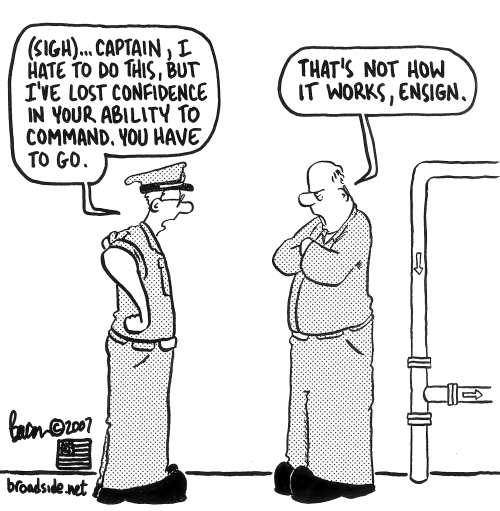
Courage of his convictions – the Aid for Operations resigns his post
Admiral Fiske has the courage of his convictions and they are founded on knowledge and experience. He believes that what he said about the bad condition of our Navy before the House Committee on Naval Affairs last December was strictly true; that it is unprepared for emergency and has lacked facilities for training its men for war work. Granted that the Admiral may be a trifle pessimistic and inclined to look to the dark side, no testimony whatever in contradiction to his statements has been forthcoming.
The country has abundant faith in its Naval officers, while it has no reason to be confident of the good judgment of the civil head of the Navy. Perhaps Secretary Daniels is as well fitted to his exhalted position as many of his predecessors, but these are perilous times and there is a widespread desire to have our defenses put in good order. It seems that the statements of an officer of the large experience of Admiral Fiske should be heeded. It is not to be doubted that he has the good of the Navy and of the country at heart.
The withdrawal of Admiral Fiske from his post as Aid for Operations in the Navy Department is not a matter of trifling importance. As the foremost among the advisers of the Secretary, his appointment to the new post of Chief of Naval Operations seemed logical. The report is that the Admiral has requested to be transferred because he is not in accord with the policy that prevails at the department. What is that policy? The people would like to know. Is it chiefly concerned with the prevention of the use of alcoholic liquor and the appointment of new chaplains? Does it depend altogether on the Secretary’s conception of himself as a headmaster in a school? If so, it is perhaps an amiable and well-meant policy, but it does not meet present requirements.
The inference that an experienced officer like Admiral Fiske would prefer not to take up the responsibilities of Chief of Naval Operations under the present conditions, is somewhat disturbing.
The New York Times, April 4, 1915