Aid to Navigation

Friendships with Your Navy Seniors

Such friendships usually take the form of a mentor relationship and it often starts with your skipper or other boss taking special interest in your performance and career development. But he or she will be very careful to keep official relationships official because they must be concerned with the performance of the department or unit as a whole and not play favorites. Typically such mentoring matures after you or your boss have been detached. But I should raise a caution flag. (An aid to navigation, if you will.)

You will notice that most, if not all, skippers or bosses will address you by your first name. The reverse is, of course, not in order. Don’t think for a minute that because your skipper or boss addresses you by your first name that you are his or her friend. Not yet, anyway. Seniors will have occasion to chew you out (the more modern term is counseling) but don’t think that because they use your first name on such occasions that they are counseling you as a friend. You are being “wire brushed” as an errant subordinate.

Moreover, your skippers are not social workers who are inordinately concerned about your “feelings”, perceived inadequacies, or your self esteem. They are interested in whether or not you are pulling the wagon, doing your duty, and growing professionally, Friendship has absolutely nothing to do with it.


The Professional Naval Officer – A Course To Steer By

RADM James A. Winnefield
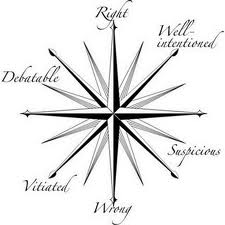
The Navy’s Moral Compass – Askew

Nice article by Captain Mark Light HERE.  The CNO’s Charge of Command is HERE.  With regard to the CO of USS PITTSBURGH, the Submarine Squadron Commander, Captain Vernon Parks personally reviewed the CNO’s Charge of Command with Commander Ward.  Perhaps Commander Ward thought past offenses were not covered by the Charge of Command and he intended to comply fully upon assumption of command?

CO of USS PITTSBURGH washes out

Commander Mike Ward, commanding officer of the fast attack submarine USS PITTSBURG (SSN 720) was fired on 10 August 2012 for  “allegations of personal misconduct.” 
Captain Vernon Parks, commander of Submarine Development Squadron TWELVE said that Commander Mike Ward understood the CNO’s Charge of Command and failed to uphold them.
Commander Ward had been in command for only a week.  The former CO of USS PITTSBURGH, Commander Mike Savageaux, reassumed command temporarily – a rare circumstance indeed.

Some lessons from the U.S. Navy

Knowledge sharing is deeply (though not nearly deeply enough for my liking) ingrained in the culture of the Navy.

Here’s how they do it so well:

  1. Training.  Every warfare specialty in the Navy has a school associated with it, whether it is assembling bombs, running the dining facility, or dogfighting in an F/A-18.  It all starts with training, which is constantly updated by new knowledge and experience from the fleet.
  2. Qualification Boards.  In order to advance in rank or earn a specific qualification insignia such as lead the watch team in the reactor plant, a qualification board is organized with a sailors superiors and qualified peers to test his or her knowledge. And not just the book or classroom knowledge matters; the subtleties, nuances, good judgment, experience count as well.  (what we call tribal knowledge)
  3. Practice.   Every hour of every day, each Sailor is constantly practicing their assigned role in every imaginable scenario.  Man overboard, fire, damage control, chemical attack, intruders, injuries, aircraft incident.  You name it, they practice it until it is second nature.
  4. Reviews.  Every exercise, getting underway from the pier or a coordinated Strike Group operation ends with a detailed lessons learned review, which is fed back into the system to improve the next time through.
  5. Progression.  The Navy has designed this ingenious system of enabling its Sailors with a progression of knowledge gained by a minimum amount of time in each job and rank with a required set of qualifications before they can advance in their career.  Relatively short assignments encourage broad experience and constant learning.

 Written by Craig Malloy, CEO of Bloomfire, an Austin startup that offers knowledge sharing applications for teams and organizations. Craig previously served as Founder/CEO of ViaVideo (acquired by Polycom), Founder/CEO LifeSize (acquired by Logitech), and is a former Navy officer.

The full post is HERE.

Protect the risk takers


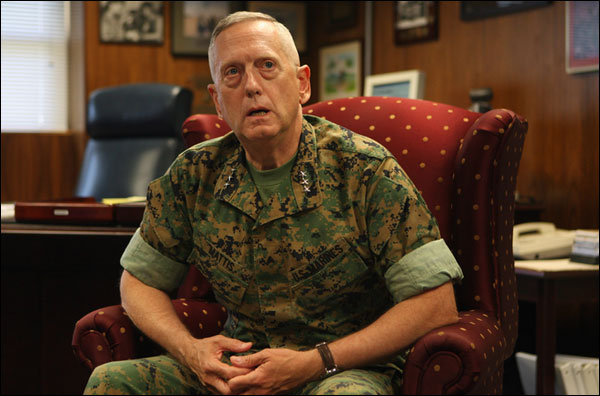
“If you are always on the hunt for complacency, you will reward risk-takers, and people who thrive in uncertainty.”


“Take the mavericks in your service, the ones that wear rumpled uniforms and look like a bag of mud but whose ideas are so offsetting that they actually upset the people in the bureaucracy. 

One of your primary jobs is to take the risk and protect these people, because if they are not nurtured in your service, the enemy will bring their contrary ideas to you.”

General James Mattis
United States Marine Corps

We will not forget you Shipmate

Cryptologist Technician (Collection) Petty Officer 1st Class (Expeditionary Warfare Specialist) Michael J. Strange, 25, of Philadelphia, Pennsylvania gave his life for his country a year ago today while supporting Operation ENDURING FREEDOM.  He and 29 fellow warriors died in Wardak province, Afghanistan when their CH-47 Chinook helicopter was shot down by enemy forces. 
As Vice Admiral Kendall Card said a year ago:
“Petty Officers Day and Strange represent the best of what we aspire to be: Warriors, fighting in service to our country.  Their dedication to the mission, our Navy, and the United States of America must not be forgotten as we join their families and Shipmates in mourning their loss.
Please join me in offering a salute to Petty Officers Strange and Day,  as well as the other 28 American heroes we lost – they made the ultimate sacrifice so that we all can enjoy the freedoms many take for granted.  We honor them for their dedicated service, and offer our heartfelt condolences to their families, friends, and Shipmates.”
You can read more about Michael HERE.

Very nice tribute on the NIOC PENSACOLA blog http://www.niocpblog.wordpress.com

First real update since 1994 in the SORN – Duties of the Information Warfare Officer

3.18.5 INFORMATION WARFARE OFFICER (IWO)
a. GENERAL DUTIES. The IWO is responsible for operating and maintaining cryptologic systems and related spaces, and providing combat information to CIC.
The IWO conducts full spectrum cyberspace operations including elements of defensive cyberspace operations (DCO) and offensive cyberspace operations (OCO) in the form of operational fires through the electromagnetic spectrum as directed.
b. SPECIFIC DUTIES. Advise and assist the Operations officer in planning for the employment of cryptologic systems. Conduct ship cryptologic intercept operations and when directed, coordinate intercept operations between units. Develop combat information from cryptologic intercept. Provide information to support intelligence requirements and objectives identified by or levied on the command. Operate and maintain special security communications circuits. Establish necessary access and employ cyberspace related cryptologic and electronic warfare systems to conduct DCO and OCO.
c. ORGANIZATIONAL RELATIONSHIPS. The information warfare officer reports to the intelligence officer (CVN) or operations officer (CRUDES).