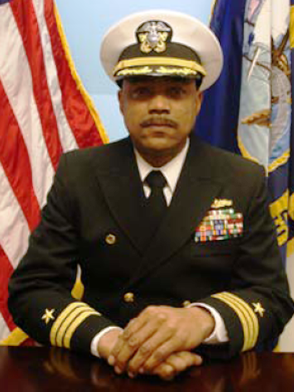
VADM James Bond Stockdale Inspirational Leadership Award Winner to be CNO

Navy Flag 
 Officer Biography

Admiral Jonathan W. Greenert

Admiral Jonathan W. Greenert
Admiral Jonathan W. Greenert is a native of Butler, Pennsylvania. He graduated from the U.S. Naval Academy in 1975 and completed studies in nuclear power for service as a submarine officer.

His career as a submariner includes assignments aboard USS Flying Fish (SSN 673), USS Tautog (SSN 639), Submarine NR-1 and USS Michigan (SSBN 727 – Gold Crew), culminating in command of USS Honolulu (SSN 718) from March 1991 to July 1993.

Subsequent fleet command assignments include Commander, Submarine Squadron 11, Commander, U.S. Naval Forces Marianas, Commander, U.S. 7th Fleet (August 2004 to September 2006) and Commander, U.S. Fleet Forces Command (September 2007 to July 2009).

Greenert most recently served as vice chief of naval operations. Greenert has served in various fleet support and financial management positions, including deputy chief of naval operations for integration of capabilities and resources (N8); deputy commander, U.S. Pacific Fleet; chief of staff, U.S. 7th Fleet; head, Navy Programming Branch and director, Operations Division Navy Comptroller.

He is a recipient of various personal, and campaign awards including the Distinguished Service Medal (5 awards), Defense Superior Service Medal and Legion of Merit (4 awards). In 1992 he was awarded the Vice Admiral James Bond Stockdale Award for inspirational leadership. He considers those awards earned throughout his career associated with unit performance to be most satisfying and representative of naval service.

IW – REMOVED as an approved Joint term in IO Doctrine — How did I miss this?

SUMMARY OF CHANGES REVISION OF JOINT PUBLICATION 3-13
13 February 2006

A few key changes that you may have missed:

  • Aligns joint information operations (IO) doctrine with the transformational planning guidance as specified by the 30 October 2003 Department of Defense Information Operations Roadmap.
  • Discontinues use of the terms “offensive IO” and “defensive IO” but retains the recognition that IO is applied to achieve both offensive and defensive objectives.
  • Removes information warfare as a term from joint IO doctrine.

The JP 3-13 glossary provides this definition of information warfare.
Term                                        Definition 
Information Warfare.     None. (Approved for removal from the next edition of JP 1-02.)

JP 1-02 also changes IWC from  Information Warfare Commander to Information Operations Commander.

Does this mean anything? What is the Joint message here?

People – Most Important Asset?

How often have we heard the mantra from our senior leadership that ‘people are the Navy’s most important asset’? Far too often is the answer. The fact is that many of our senior leaders who have made that statement, that either didn’t really believe it, or didn’t work hard enough to deliver on it.
That’s about to change and the reasons are obvious.
The truth is, people not only make a difference, they are the difference between our Information Warfare/Cryptologic community and the others. How our community leaders plan to lead our community is what will make the difference between failure and success of ‘this great N2/N6 Information Dominance experiment’, as the CNO has described it.
Rear Admiral Rogers and the rest of the IW/Cryptologic leadership team know that effective community management is a shared responsibility.  It is about creating and engaging the right workforce to meet Navy objectives and achieve sustainable competitive advantage against our adversaries (internal and external). They are all actively involved in the IDC cross detailing and IWO slating process to ensure that we are getting the right people in the right place at the right time to get the right things done.  When people are engaged, and are given clear direction and the right kind of support—everything from effective leadership to valuable training to rewards that drive the right behaviors and results—there is not anything that they cannot achieve.
Rear Admiral Rogers and the rest of the IW/Cryptologic leadership team are prepared to engage the community, give clear direction and provide the right kind of support.  Cast off all lines and prepare to get underway.

The Disease Has Been Diagnosed

“Diversity Fatigue” has become an epidemic in organizations across the U.S. because focus on race and gender alone has not created a significant and measurable business outcome. Hiring and promoting women and people of color — which was once the “correct” thing to do — has only served to produce representation metrics and little accountability to business objectives.  This was clearly demonstrated by the elimination of several diversity-related jobs in corporations during the recent recession. When forward-looking business leaders increased the participation of the workforce in the business process, the value of a diversified workforce increased markedly internally and externally.
From SmartBlog on Leadership HERE.
Some suggestions for combating “Diversity Fatigue” are HERE.

Words of wisdom

If our bright young officers don’t bring new ideas to us because we don’t ask for them, I think that that reveals a command structure that doesn’t accept failure and is not eager to learn from its mistakes, which I think is a huge shortcoming of our Navy system. Failure is not bad. Not learning from the failure is bad, but failure is not bad.


A bright young Flag officer
OPNAV Staff

Several of our IW Flags attended Leading Innovation Course at Babson College

As part of the Navy’s Executive Development Program (NEDP), several of our IW Flag officers traveled to Babson College, Babson Park in Massachusetts for the Leading Innovation (LI) Course from 23-26 August 2011.   Here’s what the course is for: 
The Leading Innovation Course is an intensive, four‐day course designed to provide senior Navy leaders with both the skill set and the mindset to understand the critical nature of innovation as it relates to organizational success in the Navy.  The program focuses on building and sustaining an innovative organization that produces measurable results in a business and organizational context. The LI Course delves into the practice of innovation through case studies, small‐team exercises, and interactive class discussions. Our IW Flags were challenged to broaden their thinking process through exposure to new ideas and thoughtful examination of their own roles as “leaders of innovation” in the Navy.

The Objective/Desired End State
A cadre of Navy flag officers with both the skill set and mindset to understand and apply the critical nature of innovation and entrepreneurial thinking to achieve organizational success. 

Navy Fires 17th Commanding Officer

Commander Laredo Bell, commanding officer of Naval Support Activity Saratoga Springs, N.Y., was fired Wednesday following an August 20 driving while intoxicated arrest.  Rear Admiral Mark Boensel, commander of Navy Region Mid-Atlantic, fired Bell due to a “loss of confidence in his ability to command.”

Commander Bell, a native of Birmingham, Alabama enlisted in the Navy in 1981 and was an initiated Chief Petty Officer before earning his commission as a limited duty officer in October 1992.
Commander Bell’s personal decorations include the Meritorious Service Medal, the Navy and Marine Corps Commendation Medal (10 Awards), the Navy and Marine Corps Achievement Medal (4 Awards) along with numerous unit and service awards.

Commander Bell had been in command since December 2010.

Remarkable Strategy for Connecting With His Commanding Officers

How about this for finding out where your people stand?

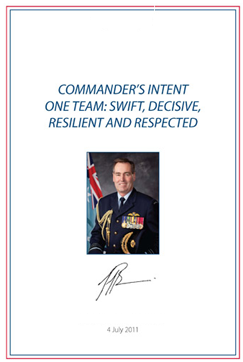
Let them know where you stand.  And find out where they stand by exchanging ‘commander’s intent’ messages.

I have not seen anything like this before.  Imagine: A senior leader sends his destroyer squadron his “Commodore’s Intent” and asks each of his Commanding Officers to send him ‘their’ intent in the form of a handwritten essay of their command intentions for the next two years.  This is a novel way of finding out if your Skippers can write and a great way for them to connect their command intentions with those of the Commodore.

Commander’s Intent – A way to deal with incomplete or changing requirements

Commander’s Intent is a military concept. It seems to have been first articulated by the Prussians after their defeat by Napoleon’s conscript army in 1806. Commander’s Intent is “the commander’s stated vision which defines the purpose of an operation, the end state with respect to the relationship among the force, the enemy and the terrain; it must enable subordinates to quickly grasp the successful end state and their part in achieving it”.

by Sanjay Mishra

Navy Baggage – can not let it go

Let me say that I am carrying a lot of Navy baggage. I remain connected to the Navy from my very first day at the MEPS in St Louis, Missouri. Carry that through bootcamp in San Diego, California and a succession of great assignments in the Navy (Monterey, CA; San Angelo, TX, Misawa, JA; Newport, RI, San Diego, CA; Atsugi, JA; Barbers Pt, HI; Monterey, CA; Washington DC; Yokosuka, JA; Corry Station, FL and then Washington DC with 100 destinations in between).

I can’t let any of it go. I carry memories, lessons learned and friendships from each command with me to this very day. I can honestly say that I have maintained contact with a Shipmate from each and every place I have been. I can’t let that baggage go.