Admiral Ferguson relieves Admiral Greenert as VCNO

Vice Chief of 
 Naval Operations
8/22/2011 – Present

Admiral Mark E. Ferguson III

Admiral Mark E. Ferguson III

Following graduation from the U.S. Naval Academy with the Class of 1978, Admiral Ferguson completed nuclear power training prior to entering the fleet as a surface warfare officer.

His afloat assignments include service on board USS South Carolina (CGN 37), USS Fife (DD 991) and USS Dwight D. Eisenhower (CVN 69). He commanded the USS Benfold (DDG 65) and Destroyer Squadron 18. In addition to various staff assignments, he served as the assistant commander, Navy Personnel Command, chief of legislative affairs, and chief of naval personnel.

Ferguson holds a master’s degree in computer science from the Naval Postgraduate School and completed a National Security Fellowship at the Harvard Kennedy School. His awards include the Navy Distinguished Service Medal, the Defense Superior Service Medal, and various unit and campaign awards.

More work for Fleet Cyber Command

http://www.networksolutions.com/blog/author/JLoong/

OPNAV INSTRUCTION 3432.1A
From: Chief of Naval Operations
Subj: OPERATIONS SECURITY

c. Commander, U.S. Fleet Cyber Command (COMFLTCYBERCOM) shall:
(1) Coordinate and administer the Navy OPSEC program and provide oversight regarding the execution of Navy OPSEC policy, doctrine, instruction and organizational program implementation.  Maintain an OPSEC support capability for the Navy per reference (b) to include the NOST. The NOST is a subordinate element of Navy Information Operations Command (NIOC) Norfolk.
(2) Assist in the identification of CI, review program and facility OPSEC plans, and offer CI and OPSEC plan endorsement to cognizant OPSEC program managers and officers.
(3) Develop and coordinate a Navy OPSEC training program, to include:
    (a) OPSEC orientation training within 60 days of reporting for duty.
    (b) OPSEC awareness training at least annually to include review of the five step OPSEC process, CI list(s), current threats and vulnerabilities, site OPSEC plan, and results of OPSEC assessments and surveys.
    (c) OPSEC planner training for individuals with OPSEC planning responsibilities.
    (d) OPSEC training for naval reservists assigned to mobilization billets.
(4) Assist in the conduct of OPSEC self-assessments or formal OPSEC surveys as directed.
(5) Provide OPSEC planning assistance and guidance to fleet units.
(6) Identify and submit appropriate OPSEC lessons learned into the NAVWARDEVCOM lessons learned database. Solicit community best practices for consolidation and updating appropriate policy and tactics, techniques, and procedures (TTP).
(7) Consolidate annual status reports per table (1) of reference (f) from echelon 2 and 3 OPSEC program managers no later than 7 November of each year. Analyze and forward results to echelon 1 no later than 15 November of each year.
(8) Submit at least one suitable Navy candidate for the annual national OPSEC awards program to the national Interagency OPSEC Support Staff (IOSS) no later than 1 December of each year. Instructions for submitting the awards packages are located on the IOSS Web site: https://www.iad.gov/ioss/department/national-opsec-awards-10021.cfm.
(9) Act as the point of contact for Navy OPSEC program concerns, including primary monitoring of the electronic messaging account OPSEC@navy.mil.

And this:

h. COMFLTCYBERCOM, with its subordinate command, NIOC Norfolk, is the primary review authority for IO doctrine, and maintains the Warfare Center of Excellence for IO. COMFLTCYBERCOM, via NIOC Norfolk, shall coordinate with NAVWARDEVCOM to ensure Navy OPSEC TTP’s are effective, relevant, and responsive to fleet requirements.

Chief Petty Officer 24/7/365

“I expect you and every member of your Mess to exercise the leadership and professionalism that we are entrusted with each and every day; hence CPO 365.  We each know the difference between right and wrong and will be held accountable.  I have the utmost confidence in our ability as a Mess to continue to build upon the legacy of success forged by all that have worn anchors.  HOOYAH CHIEFS, ANCHOR UP!”

Master Chief Petty Officer of the Navy, Rick West
MCPON’s 2011 CPO 365/Induction Guidance (ANCHOR UP!) 

**Anchor Up** introduced in September 2007 in my USNI PROCEEDINGS article.

Naval Officer

As the Officer Fact Book, NavPers 15898, states, the naval officer is above all a leader – responsible for directing the human effort of an organization and for property and lives.  The naval officer is a planner, responsible for large scale mobilization and world-wide logistic programs and operations.  He is an administrator concerned with thousands of people, millions of dollars worth of material, and extensive facilities.  He is an industrialist, a comptroller, a diplomat; a good manager of men and equipment, an exemplary ambassador of democracy in all parts of the world.  He is always a student.  His opportunities for experience are varied, and for education they are limitless.  As he improves in his job, he improves the naval service and contributes to the welfare of the nation and the world.

Common force packages needed to get to the next stage of cyber integration

By Daniel Wasserbly

IHS Janes

6/15/2011


The ability to provide common force packages to commanders for network operations is a needed precursor to enabling freedom of manoeuvre for joint forces in the cyber domain, according to US military officials.

Commander Scott Coughlin, Director of Current Operations for the US Navy’s Fleet Cyber Command, said the military needs a common lexicon, common force structure and packages and a clearer understanding of available cyber capabilities as well as the limitations, restrictions and authorities involved.

Refining such constructs is “one of the most critical things that we need to have in order to get to that next stage in the integration of cyber”, Cdr Coughlin told a cyber security summit in Arlington, Virginia, on 3 June.

Agenda and speakers for the Cyber Summit are HERE.

Military honors for CTR1(EXW) Michael Joseph Strange in Pennsylvania

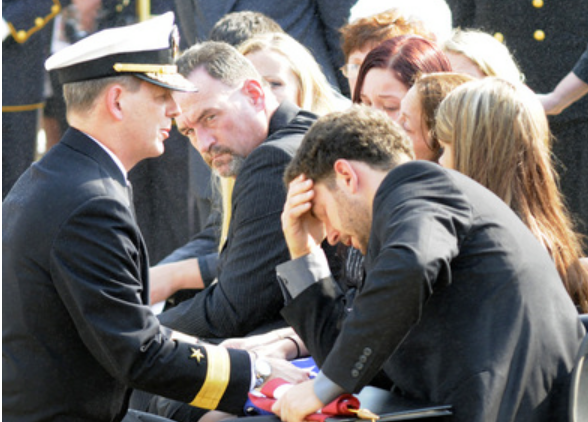
RDML Leigher presents flags to Mike’s family.
Rear Admiral Bill Leigher, OPNAV N2N6F and the Information Warfare/Cryptologic community leader, traveled to Philadelphia on 18 August to remember Cryptologic Technician Collection First Class (CTR1) Expeditionary Warfare Specialist (EXW) Michael Strange (who was killed on 6 August in Afghanistan) and pay his respects and those of a grateful Navy and Nation to Michael’s family.  RDML Leigher described Mike’s DEVGRU teammates as “rocks”. Together with the Navy Information Operations Command Maryland color guard, his teammates presented a memorable military honors ceremony after the funeral mass.

Ideas – Testing them on the intellectual field of battle

Share your ideas in print – a scholarly journal, a military magazine, a literary journal, or even a blog post. Get out there with your ideas. Nail your whispers to the wall. Conclude the trilogy of read … think … and write. Is there “career risk” in publishing? I suppose. Hasn’t hurt me too badly over the years, I’d say. But what matters is testing your ideas on the field of intellectual battle, so to speak.
We need to challenge our staffs, our friends, our shipmates, our allies—the dedicated professionals who work with us every day. And we need to constantly seek new relationships and forge new partnerships.
Admiral James R. Stavridis
Supreme Allied Commander, Europe
Commander, US European Command

N2/N6F1 – Net-Centric Capabilities Division

Rear Adm. (lower half) Diane E. H. Webber will be assigned as director, Net-Centric Capabilities Division, N2/N6F1, OPNAV, Washington, D.C.  RDML Webber is currently serving as director for command control systems, J6, Headquarters North American Aerospace Defense Command/director, architectures and integration, J6, U.S. Northern Command, Peterson Air Force Base, Colorado.

Rear Admiral Diane E. H. Webber

Headquarters North American Aerospace Defense Command and United States Northern Command
Director, Command Control Systems

Rear Admiral Diane E. H. Webber

A native of Missouri, Rear Admiral Webber graduated summa cum laude, with honors, from William Jewell College with a Bachelor of Science degree in Music Education. She is currently the director, Command Control Systems, for the North American Aerospace Defense (NORAD) Command and United States Northern Command USNORTHCOM), Peterson Air Force Base, Colorado. She is responsible for synchronizing command-wide information superiority and architecture efforts to enable the commander, NORAD and USNORTHCOM, planning and executing military operations throughout the Area of Operation and providing military assistance to civil authorities including consequence management operations.

Webber’s operational tours include early assignments as an oceanographic watch officer at U.S. Naval Facility, Argentia, Newfoundland and commander, Oceanographic Systems, Pacific. She deployed as combat systems officer in USS George Washington (CVN 73) when the ship earned two Battle E’s, the Admiral Flatley Safety Award and the Battenberg Cup. During Operation Iraqi Freedom, she commanded U.S. Naval Computer and Telecommunications Station, Bahrain. Webber was assigned to Multi National Forces, Iraq as director, Communications and Information Systems (CIS) Coalition Force Plans/Joint Network Control Center (JNCC) and subsequently served as director, Communications Information Systems, 2nd Fleet.

Other tours include assignments as officer in charge at both Surface Ship Anti Submarine Warfare Analysis Center, San Diego and Communications Security Material Issuing Office, San Diego. Webber was then assigned as the Navy’s enlisted advancement planner for the Enlisted Plans and Community Management Branch in the Bureau of Naval Personnel and served as executive officer, Naval Computer and Telecommunications Station, Washington. She has been the director of Operations and Readiness at commander, Naval Computer and Telecommunications Command as well as the operations officer and director, Global Network Operations and Space Center at Naval Network and Space Operations Command, Dahlgren. She was also executive assistant to the deputy chief of naval operations for Communication Networks (N6) at OPNAV.

Webber holds a Master of Arts in Management from the University of Redlands (California) and a Master of Military Science from the USMC Command and Staff College. She is a recipient of the Naval Historical Center’s Admiral Samuel E. Morison Supplemental Scholarship and has completed her doctoral coursework in International Relations at Catholic University. She holds certificates in Chief Information Officer and Information Assurance from Information Resource Management College at National Defense University and Information Operations from Naval Postgraduate School.

Webber’s personal awards include the Legion of Merit, the Defense Meritorious Service Medal, the Meritorious Service Medal, the Joint Service Commendation Medal, the Navy and Marine Corps Commendation Medal, the Navy and Marine Corps Achievement Medal and numerous unit and campaign awards.

A Naval Officer’s Character – Failure To Live Up To Those High Expectations

It is abundantly clear and readily apparent to the most casual observer that other officers, Sailors, Chiefs and their families will quickly look past the veneer of your lineage and the silver oak leafs or eagles on your collar.  
Our officers, Sailors, Chiefs and their families have a unique ability to see past all that, and perceive the foundation you are building. They know when you are on rocky ground. They can sense the weakness in you. 

They will perceive your character and all its inherent defects. Some great man once said, “The true character of a Naval officer cannot be hidden from his/her Sailors.” There is no place to hide.  

The three words of my persistent drumbeat – Write…Write…Write

Okay, it’s really Read…Think…Write

From my friend –
Admiral James Stavridis

“In the end, the quintessential skill of an officer is about bringing order out of chaos. To do that, you have to be calm, and smart, and willing to do the brain work. Because in the end, 21st Century security is about brain-on-brain warfare. We will succeed not because we have more resources, or because our values are the best, or because we have the best demographics or geographic advantages—all of those things matter, of course. But in today’s turbulent 21st Century, we’ll succeed and defeat our enemies by out-thinking them. To do that, and to be successful senior officers, you need to read … think … and write.”